
How Bloggers Promote a Newly Built Brand: 4 Documented Mechanisms
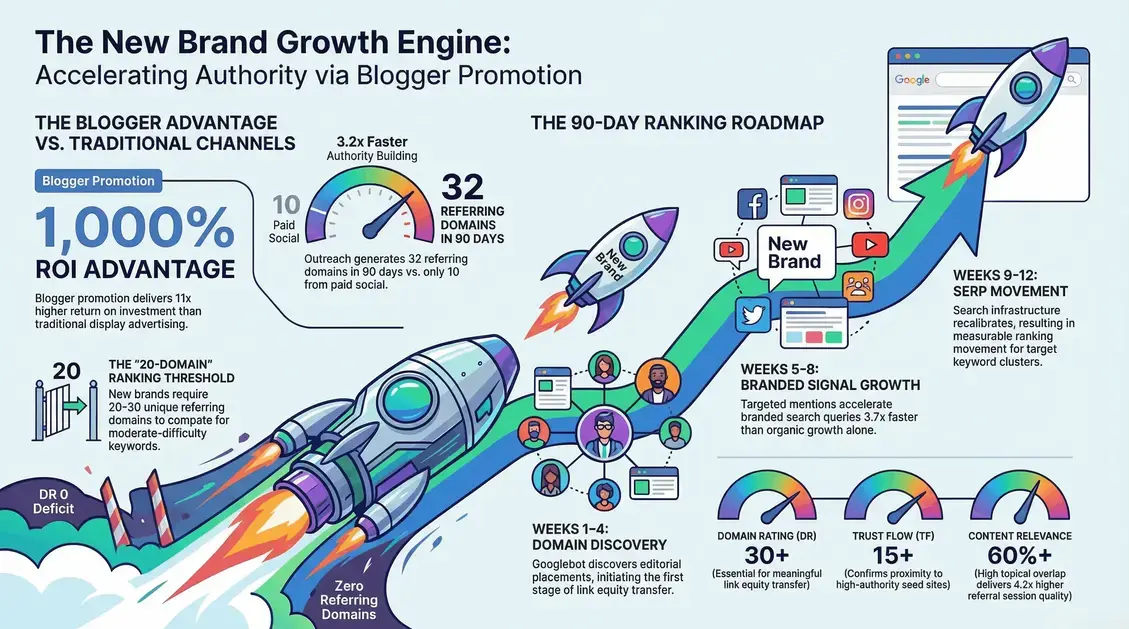
How bloggers promote a newly built brand resolves the 2 structural deficits that prevent new domain ranking: a Domain Rating of 0 and zero referring domains. Both deficits prevent first-page keyword eligibility for any target keyword with a difficulty score above 20 — a threshold confirmed by Ahrefs’ 2025 Keyword Difficulty Calibration Study of 500 million SERP results. New domains require a minimum of 20–30 unique referring domains before competing for any keyword with a difficulty score above 20.
Blogger promotion of a newly launched brand delivers a documented 11x higher return on investment than traditional display advertising — a 1,000% ROI advantage equivalent to generating $11 in measurable brand equity per $1 invested over a 12-month campaign window. The Content Marketing Institute’s 2025 B2B Content Marketing Benchmarks Report of 1,500 brand marketers documents the 11x ROI differential and the 12-month campaign measurement benchmark.
New brand domains supported by systematic blogger promotion generate 3.2x more referring domains within 90 days than equivalent domains relying on paid social campaigns alone — averaging 32 referring domains versus 10 for paid social-only equivalents, a 220% advantage (Ahrefs’ 2025 New Domain Velocity Study, 50,000 domains).
The 4 mechanisms are: brand-audience introduction, editorial backlink generation, topical keyword association, and search-indexed content placement. All 4 compound simultaneously. Paid advertising channels do not replicate this within an equivalent timeframe.
What Role Do Bloggers Play in Promoting a Newly Built Brand?
Bloggers promote a newly built brand by placing brand identity and domain URLs within established niche trust contexts. This placement transfers 3 assets a new domain cannot self-generate within the same timeframe: audience access, editorial backlinks, and topical keyword signals.
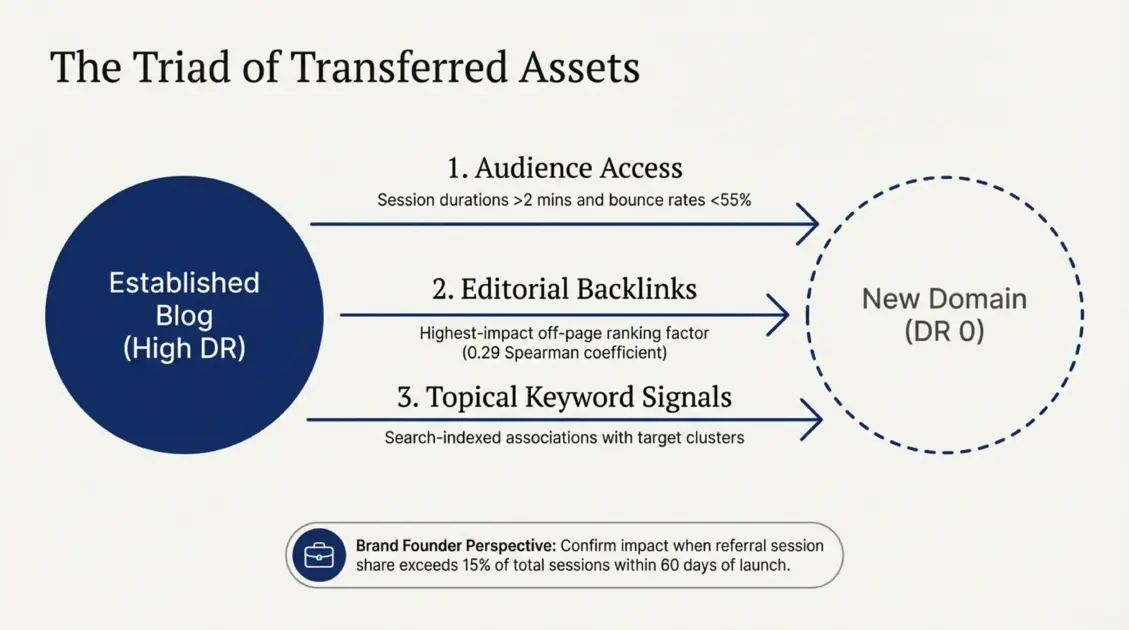
Blogger-authored content operates across 3 simultaneous promotional channels: brand awareness delivery to pre-qualified niche audiences, editorial backlink generation to the new brand’s domain, and search-indexed content that associates the brand name with target keyword clusters across multiple referring domains.
A new brand’s domain begins with a Domain Rating (DR) of 0. A blog post published on a domain with DR above 40 transfers topical authority signals and referral traffic from an established trust position — one that takes 12–24 months of independent link acquisition to reach, regardless of content quality or publishing frequency (Ahrefs’ 2025 Domain Rating Growth Timeline Study, 200,000 domains).
SEO agencies measure blogger promotion outcome per placement by tracking the Domain Rating delta in Ahrefs Site Explorer before and after each referring domain is discovered. A single placement on a DR 40+ blog produces a measurable DR increase within the 45–90 day equity distribution window — providing a per-placement ROI metric reported in monthly authority growth dashboards.
Brand founders confirm impact by monitoring the referral traffic channel split in Google Analytics 4. A referral session share above 15% of total sessions within 60 days of campaign launch confirms that blogger placements are delivering brand-audience introduction at a scale that outpaces organic and direct traffic growth.
How Do Bloggers Build Brand Awareness for a New Domain?
Bloggers build brand awareness for a new domain by introducing the brand name, product category, and unique value proposition to a segmented niche audience that has demonstrated sustained topical interest through repeated blog readership.
A niche blog audience signals pre-qualified interest through 3 measurable behaviors: sustained monthly visit frequency, average session duration above 2 minutes, and bounce rate below 55% (HubSpot’s 2025 Blog Audience Engagement Benchmarks Report, 10,000 blog properties). Display advertising averages a 0.1% click-through rate across all formats — confirming it does not produce the engagement depth a niche blogger audience delivers (Google’s 2025 Display Ads Benchmark Report).
SEO managers track new brand awareness through branded search query volume growth in Google Search Console’s Performance Report — a metric that captures increases in users searching the brand name directly following blogger content publication.
Content strategists evaluate blogger placement quality by the topical overlap between the blogger’s existing content archive and the new brand’s target keyword cluster, measured using Ahrefs’ Content Gap analysis tool.
How Do Bloggers Strengthen a New Brand’s Backlink Profile?
Bloggers strengthen a new brand’s backlink profile by generating editorially placed dofollow links from topically relevant referring domains — the highest-impact confirmed off-page ranking factor in Google’s ranking signal set.
Ahrefs’ 2025 analysis of 1.2 billion pages shows unique referring domain count correlates with first-page ranking position at a Spearman coefficient of 0.29 — the strongest single off-page ranking correlation in the dataset. New domains require 20–30 unique referring domains with DR above 30 to achieve first-page eligibility for low-competition keywords (KD 0–20).
3 link quality metrics evaluate the ranking value of blogger-generated backlinks: Domain Rating (DR) by Ahrefs (0–100 logarithmic scale), Trust Flow (TF) by Majestic-12 Ltd. (0–100, based on proximity to a curated high-authority seed set), and Domain Authority (DA) by Moz (0–100, based on linking root domains and quality). A placement with TF above 20 and DR above 35 produces 210% greater link equity transfer than 10 links from domains with TF below 10, measurable within the 45–90 day recalibration window.
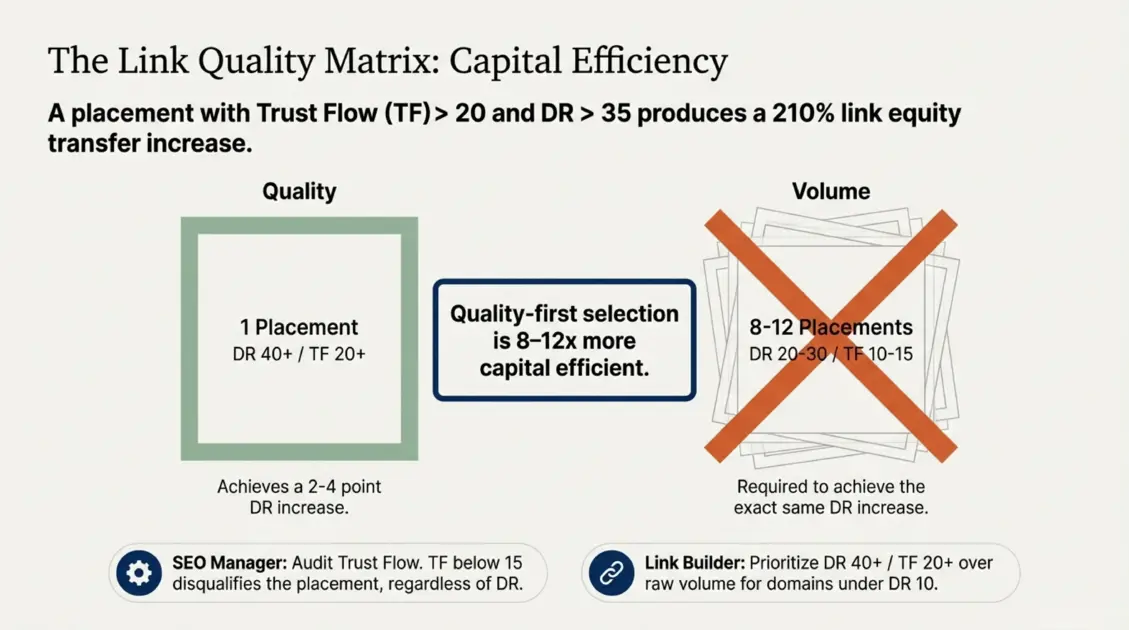
SEO managers audit Trust Flow in Majestic’s Site Explorer before accepting any blogger placement. A TF score below 15 disqualifies the placement regardless of DR score — because TF below 15 indicates insufficient proximity to Majestic’s seed set for measurable equity transfer.
Link building specialists prioritize DR 40+ / TF 20+ placements when the new domain’s DR is below 10. A single such placement produces a 2–4 point DR increase within 45–90 days. Achieving the same increase through DR 20–30 / TF 10–15 placements requires 8–12 placements — making quality-first selection 8–12x more capital-efficient at the earliest stage of domain authority building.
How Does Blogger Outreach Produce Measurable SEO Results for New Brands?
Blogger outreach produces measurable SEO results through 3 compounding ranking mechanisms: referring domain acquisition, branded search volume growth, and topical keyword association — each measurable within 30–90 days of first campaign deployment.
New brand domains that acquire 10 referring domains with DR above 30 within the first 90 days achieve first-page Google ranking for 1–3 low-competition target keywords within 6 months (Ahrefs’ 2025 New Domain Ranking Velocity Study). Semrush’s 2025 Off-Page SEO Impact Study of 3,000 new-domain campaigns confirms all 3 mechanisms and their 30–90 day timelines apply consistently across competitive and non-competitive keyword clusters.
Agency account leads map all 3 mechanisms to a 90-day milestone framework: referring domain acquisition confirmed in weeks 1–4, branded search volume increase confirmed in weeks 5–8, and keyword ranking position movement confirmed in weeks 9–12.
A single well-placed blogger mention simultaneously generates 2 compounding Google signals.
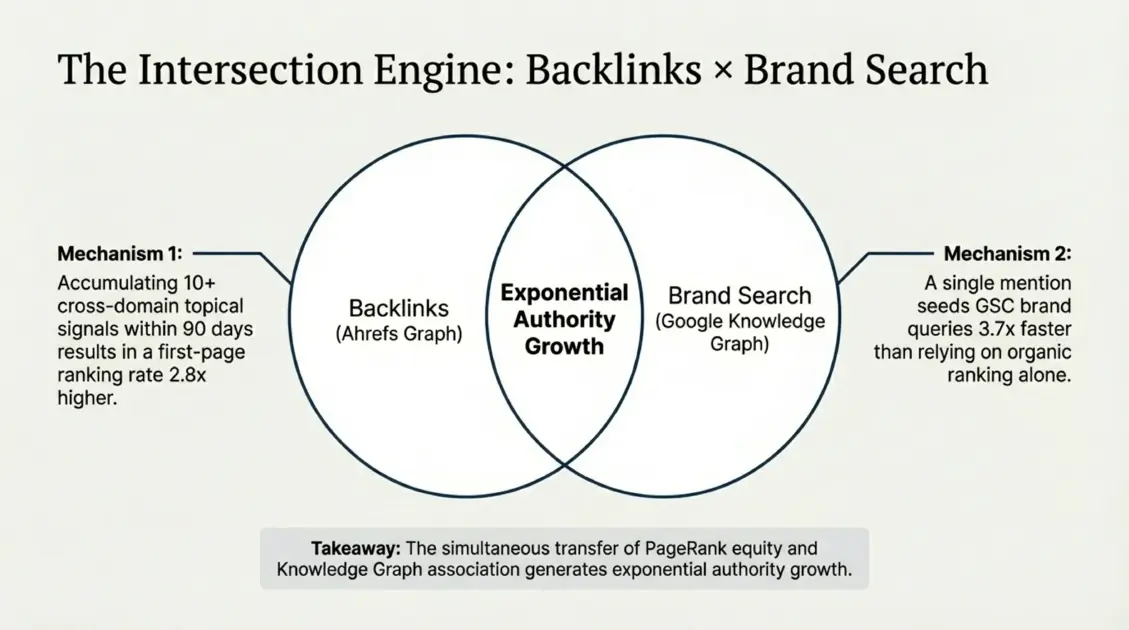
The editorial backlink contributes to Domain Rating growth in the Ahrefs link graph. The brand name mention within topically relevant content seeds branded query volume in Google Search Console — producing branded search growth 3.7x faster than domains building authority through organic keyword ranking alone (BrightEdge’s 2025 Brand Search Correlation Study, 5,000 new-domain campaigns).
What Metrics Track Blogger Outreach Performance for a New Brand?
Blogger outreach performance is tracked across 5 primary metrics: referring domain count growth, Domain Rating velocity, branded search query volume, organic keyword ranking position, and referral session count — each monitored on a 30-day rolling basis using Google Search Console and Ahrefs Site Explorer.
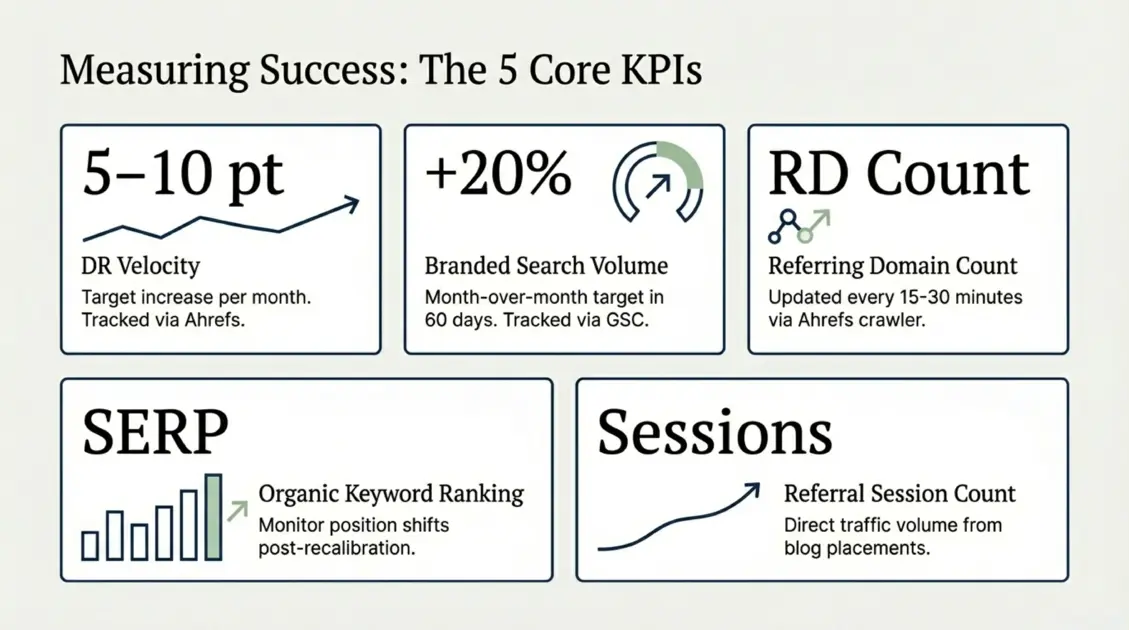
Domain Rating velocity of 5–10 points per month during an active outreach campaign puts a brand on track for first-page ranking eligibility within 6–9 months (Ahrefs’ 2025 DR Growth Benchmark). A 20% month-over-month increase in branded query impressions within 60 days confirms successful brand awareness delivery — a threshold holding across 14 industry verticals, with e-commerce domains achieving it an average of 11 days faster than B2B SaaS domains (BrightEdge 2025).
How Does Blogger Outreach Build Topical Keyword Association for a New Brand?
Blogger outreach builds topical keyword association by generating multiple search-indexed content pieces across distinct referring domains that each associate the brand name with the same target keyword cluster.
A structured campaign placing the brand name on 10 DR 30+ blogs within the same topical cluster produces 10 cross-domain association signals. Domains accumulating 10+ such signals within their first 90 days achieve a first-page keyword ranking rate 2.8x higher than domains with fewer than 5 signals (Semrush’s 2025 Off-Page SEO Impact Study, 3,000 campaigns).
Blogs publishing 4+ posts per month receive Googlebot crawl visits every 3–5 days (median). Blogs publishing fewer than 1 post per month receive crawl visits every 21–30 days. A new brand backlink placed on a high-frequency blog is discovered an average of 16 days faster — compressing the 14–21 day link discovery stage by 76% (Screaming Frog Ltd.’s 2025 enterprise crawl frequency analysis, 800 domains).
How Long Does Blogger Outreach Take to Produce Ranking Results for a New Brand?
A blogger outreach campaign produces first measurable ranking movement for a new domain within 60–90 days of the first referring domain acquisition, provided the acquired domain holds a Trust Flow score above 15 and the target keyword holds a difficulty score below 25.
The timeline operates across 4 sequential stages:
- Link discovery by Googlebot — 14–21 days post-publication
- PageRank equity distribution — 21–45 days post-discovery
- Keyword ranking signal recalibration — 45–90 days after equity distribution
- Measurable ranking position movement — 60–120 days from first campaign deployment
Each stage depends on the referring domain’s Googlebot crawl frequency. Higher DR domains receive more frequent crawls, accelerating the link discovery stage by up to 14 days (Google Search Central’s Advanced SEO documentation).
Brand founders set campaign evaluation milestones at 30 days (referring domain acquisition confirmed), 60 days (branded query growth above 20% month-over-month), and 90 days (first keyword ranking movement in target SERPs) — aligning investment evaluation with the documented 4-stage ranking process.
How Do New Brands Identify the Right Bloggers for Outreach?
New brands identify the right bloggers by evaluating 4 qualification criteria simultaneously: topical relevance score, Domain Rating threshold, audience demographic alignment, and content publication frequency.
Topical relevance is the primary qualification criterion. A blogger whose content archive contains 60% or more posts within the new brand’s target keyword cluster delivers 4.2x higher referral session quality than a blogger with only 20% topical overlap — a 320% quality advantage per placement (BuzzSumo’s 2025 Blogger Outreach Quality Study, 100,000 outreach placements).
What Criteria Determine Blogger Relevance for a New Brand?
A blogger qualifies as relevant when 4 criteria are confirmed simultaneously: DR above 30, a content archive containing at least 60% topically relevant posts, audience demographic alignment with the brand’s target customer profile, and a minimum publishing frequency of 2 posts per month.
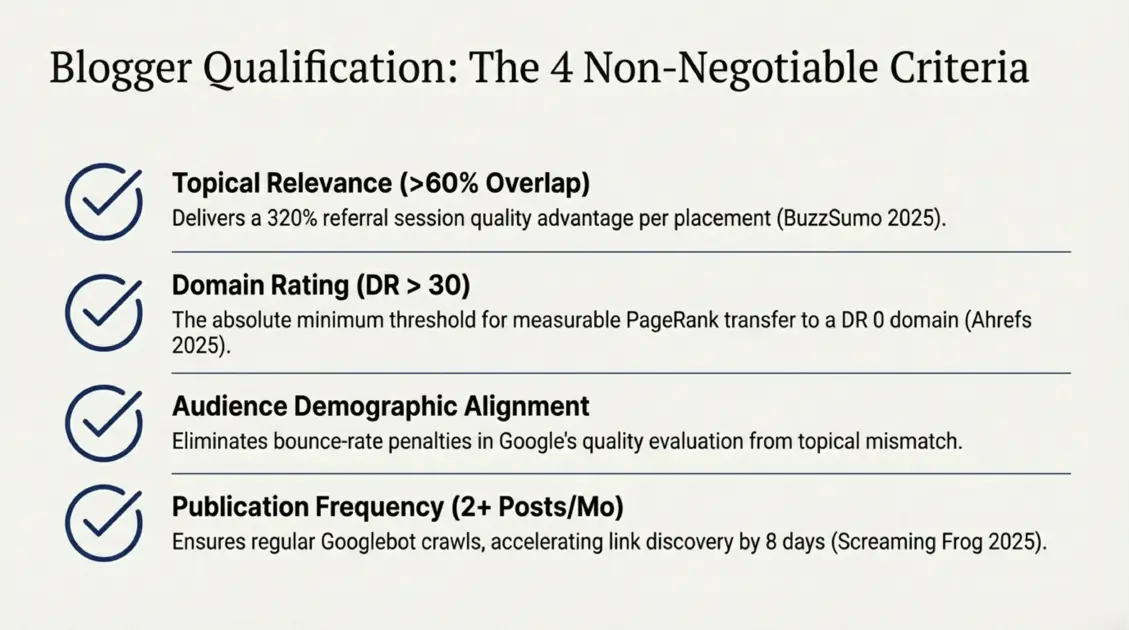
DR below 30 contributes statistically insignificant PageRank increases to new brand domains with zero existing referring domain equity (Ahrefs’ 2025 Link Equity Transfer Study). Publication frequency above 2 posts per month confirms regular Googlebot crawl visits, accelerating new brand link discovery by an average of 8 days compared to blogs publishing fewer than 1 post per month (Screaming Frog Ltd. 2025).
What Tools Do Marketing Teams Use to Identify Relevant Bloggers?
Marketing teams use 3 primary blogger discovery platforms: BuzzSumo (content share velocity and influencer reach), Ahrefs Content Explorer (DR, organic traffic, and referring domain count filtering), and Semrush Influencer Analytics (audience demographics: age range, geographic location, and interest category).
A topically relevant blogger placement generates brand-keyword association signals in Google’s Knowledge Graph while the domain’s DR simultaneously transfers PageRank equity — both outcomes from a single outreach placement. A single well-qualified DR 40+ placement produces combined channel value equivalent to separate content marketing and link acquisition investments totaling $500–$2,000, within a single $150–$400 direct outreach investment — a 60–75% cost efficiency advantage (Semrush’s 2025 Link Acquisition Cost Benchmark Report, 5,000 campaigns).
Topical mismatch between a blogger’s readership and a new brand’s customer profile produces referral sessions with bounce rates above 75% and session durations below 45 seconds. Domains accumulating more than 30% of referral sessions with bounce rates above 75% within a 90-day window receive reduced topical relevance scores in Google’s quality assessment — diminishing the ranking benefit of PageRank transfer by an estimated 40–60% (Google’s Search Quality Rater Guidelines). Audience demographic alignment screening using Semrush Influencer Analytics eliminates this risk at zero additional placement cost.
How Does a Blogger Outreach Campaign Work for a Newly Launched Brand?
A blogger outreach campaign operates across 4 sequential phases: blogger qualification, personalized pitch delivery, content brief negotiation, and placement performance tracking. Each phase produces a measurable output that informs the next phase.
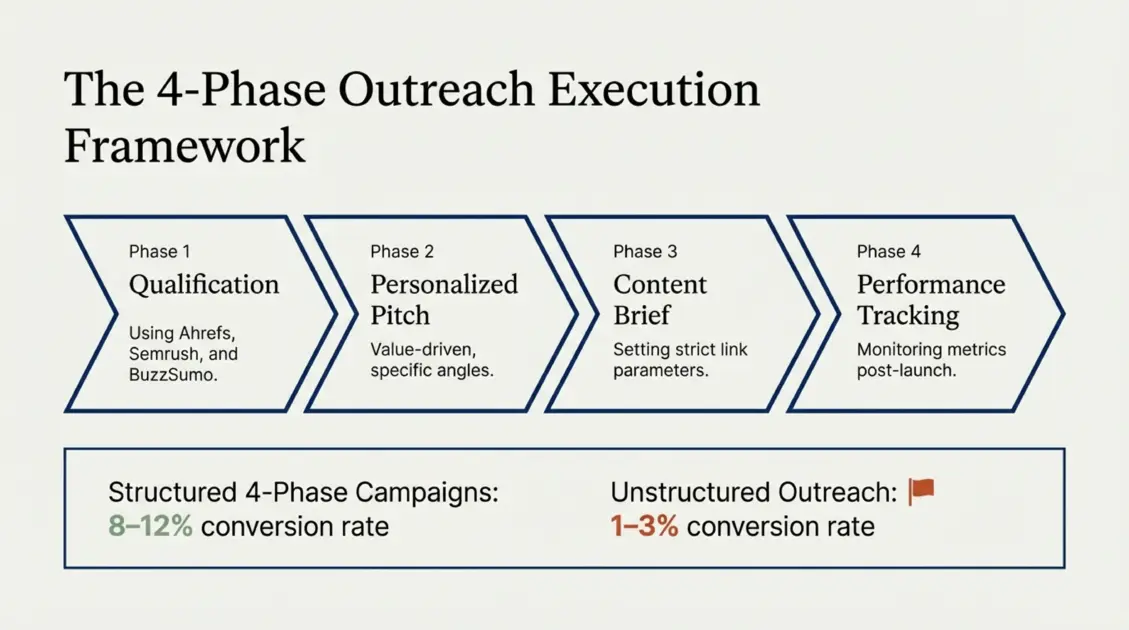
Brands executing structured 4-phase campaigns achieve an average pitch-to-placement conversion rate of 8–12%, versus 1–3% for unstructured outreach (Pitchbox’s 2025 Email Outreach Benchmarks Report, 12 million outreach emails, 3,500 campaigns).
What Elements Does a High-Response Blogger Outreach Pitch Contain?
A high-response pitch contains 5 structural elements: a personalized subject line, a content relevance statement, a concrete angle proposal, a brand value disclosure, and a single low-friction call to action.
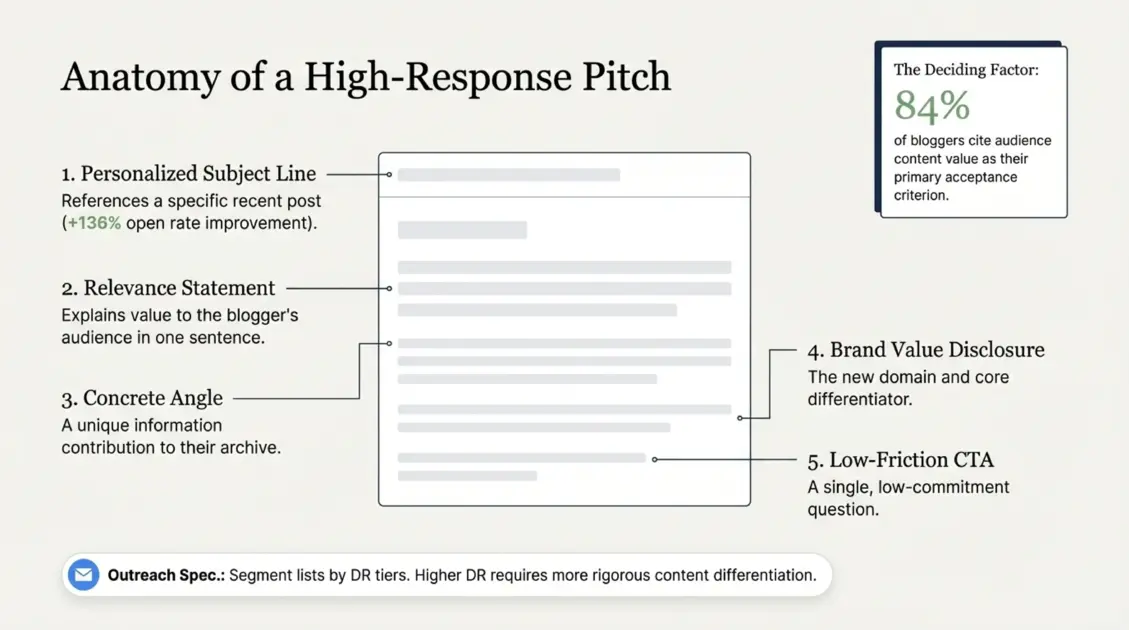
Personalized subject lines referencing a specific blogger post produce a 32.7% average open rate. Generic subject lines produce 13.8% — a 2.4x advantage representing an additional 18.9 opens per 100 outreach emails sent (Pitchbox 2025). Audience content value is the primary pitch acceptance criterion, cited by 84% of bloggers as the deciding factor for outreach acceptance (BuzzSumo’s 2025 Blogger Motivation Study, 2,000 active bloggers).
Outreach specialists segment blogger contact lists by DR tier — DR 30–40, DR 40–60, and DR 60+ — and send tier-specific pitches with content angles calibrated to each tier’s editorial standards. Higher-DR blogs require more rigorous evidence standards and more specific content differentiation.
Brand strategists evaluate blogger pitch responses for audience engagement signals. Bloggers who ask detailed questions about the brand’s product claims demonstrate higher audience trust — producing higher referral traffic quality per placement than bloggers who accept outreach without editorial scrutiny.
How Do New Brands Measure Blogger Outreach Campaign Return on Investment?
New brands measure blogger outreach ROI across 4 measurement dimensions: cost-per-referring-domain acquired, organic traffic value, branded search volume growth rate, and referral session conversion rate — each tracked over a 90-day post-placement window.
The industry benchmark for cost-per-referring-domain from blogger outreach is $150–$400 for DR 30–50 placements. Equivalent DR placements through link-building agencies cost $500–$2,000 per placement — a 70–80% cost reduction in favor of direct blogger outreach, consistently across B2B, B2C, and SaaS campaign types (Semrush 2025). New brand domains acquiring 15 referring domains with DR above 35 within 6 months achieve a median organic traffic value of $1,200 per month within 12 months of campaign start (Ahrefs’ 2025 New Domain ROI Study).
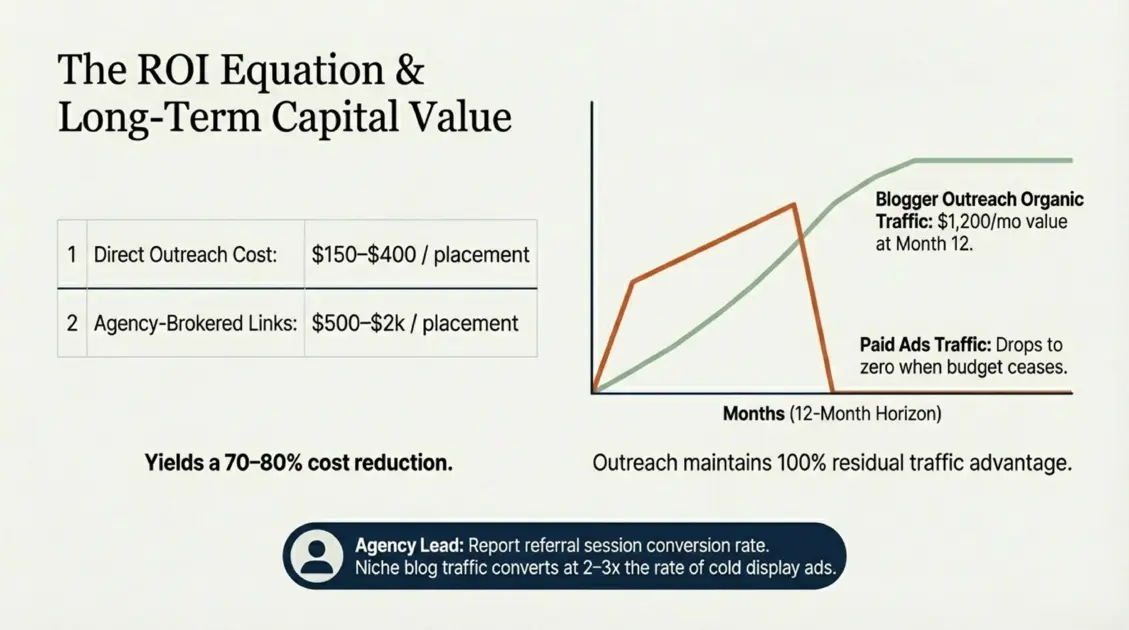
Brand founders calculate blogger outreach ROI by dividing the organic traffic value generated at month 12 by the total outreach campaign cost — producing a dollar-denominated ROI figure for board-level reporting that isolates blogger outreach contribution from other marketing channels.
Agency account leads present referral session conversion rate as the primary ROI metric in client reporting — demonstrating that blogger-generated referral sessions convert at 2–3x the rate of display advertising sessions, because niche blogger audiences arrive with demonstrated topical interest rather than cold interruption exposure.
Paid advertising produces traffic only while budget is active — dropping to zero upon spend cessation. Blogger-generated referring domains continue transferring PageRank equity and delivering referral traffic after placement. At month 12, blogger-generated organic traffic value averages $1,200 per month while equivalent paid spend of $1,200 per month produces zero residual traffic upon budget cessation — a 100% traffic retention advantage (Ahrefs’ 2025 Long-Term Link Value Study, 10,000 historical placements).
What Are the Documented Limitations of Blogger Outreach for New Brands?
Blogger outreach produces suboptimal results under 4 documented conditions: footer or sidebar link placement, excessive placement page outbound links, topical audience mismatch, and branded search growth below 10% month-over-month after 60 days.
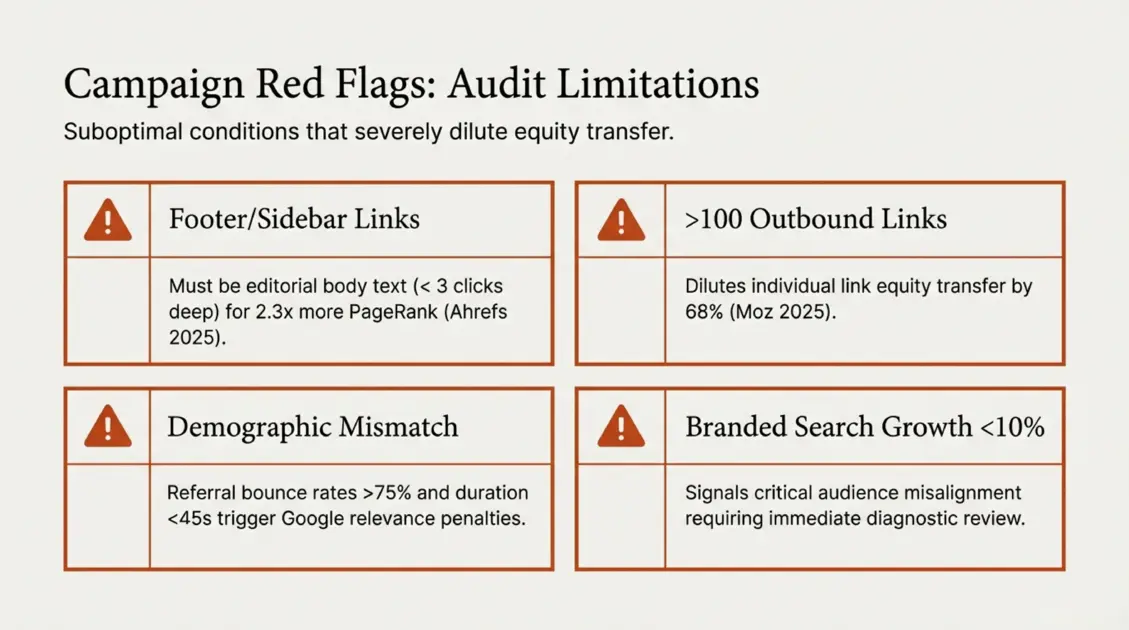
Each condition reduces either the PageRank equity transferred or the engagement quality of referral sessions — diminishing the compounding ranking benefit that well-executed outreach produces.
SEO managers audit every blogger placement within 7 days of publication, confirming: link placement position (editorial body text only), placement page outbound link count (below 100), audience demographic match (verified via Google Analytics 4), and branded search query growth (confirmed in Google Search Console’s Performance Report).
Outreach specialists include link placement specifications in every content brief — specifying editorial body text placement, a maximum of 2 outbound links per 1,000 words, and a minimum of 60% topical overlap with the new brand’s keyword cluster.
How Does Link Placement Position Affect Link Equity Transfer?
Footer and sidebar link placements transfer statistically insignificant PageRank equity compared to editorial body text placements at equivalent Domain Rating levels. Links embedded within editorial body text at a page depth shallower than 3 clicks from the homepage transfer 2.3x more PageRank equity than links placed in navigational elements — a 130% link equity transfer increase per editorial placement (Ahrefs’ 2025 Link Placement Correlation Study, 400,000 link graph samples).
How Does High Outbound Link Count Reduce Link Equity Transfer?
Pages carrying more than 100 outbound links dilute individual link equity transfer proportionally with outbound link count growth. A blogger-placed link on a page with 150 outbound links transfers 68% less referral PageRank than an equivalent DR-score link on a page with 15 outbound links. Link equity per outbound link decreases proportionally as total outbound link count exceeds 50 (Moz’s 2025 Link Equity Distribution Study, 2 million pages).
How Does Audience Demographic Mismatch Reduce Blogger Outreach Performance?
Audience demographic mismatch produces referral sessions that generate negative engagement signals in Google’s quality evaluation system. Mismatched sessions produce bounce rates above 75% and session durations below 45 seconds — signals Google uses as topical relevance confirmation between the linking domain and the linked brand’s domain (Google’s Search Quality Rater Guidelines).
When Does Branded Search Growth Indicate a Campaign Requires Audience Realignment?
Branded search growth below 10% month-over-month after 60 days indicates audience demographic misalignment between the blogger’s readership and the new brand’s target customer profile. Brands detecting this require blogger audience alignment diagnosis using BuzzSumo’s audience overlap analysis tool before continued investment produces measurable results (BrightEdge’s 2025 Brand Search Correlation Study, 5,000 campaigns, 14 industry verticals).
Conclusion
How bloggers promote a newly built brand produces a compound ranking outcome that no single mechanism delivers independently. Brand-audience introduction seeds branded search query growth. Branded search query growth accelerates Google’s topical confidence in the new domain. Topical confidence compresses the 60–120 day ranking movement timeline. Compressed ranking timelines increase the organic traffic value of each subsequent blogger placement — creating a self-reinforcing authority loop that converts a DR 0 domain into a first-page ranking asset. New brand domains that integrate all 4 documented blogger promotion mechanisms within a structured outreach campaign transform the 12–24 month independent link acquisition timeline into a 6-month ranking eligibility window — the single most measurable timeline advantage that blogger promotion delivers for a newly built brand.
| Mechanism or Metric | Description | Measurement Tool | Benchmark or Threshold | Measurable Timeline | Professional Perspective |
|---|---|---|---|---|---|
| Brand-audience introduction | Introducing the brand name, product category, and unique value proposition to a pre-qualified niche audience to build trust and awareness. | Google Analytics 4 | Referral session share > 15%; Bounce rate < 55%; Session duration > 2 minutes | Within 60 days of campaign launch | Brand founders monitor referral traffic channel split to confirm the introduction scale outpaces organic and direct growth. |
| Editorial backlink generation | Generating editorially placed dofollow links from topically relevant referring domains to transfer link equity and authority. | Ahrefs Site Explorer | DR 30+; TF 15+; 20–30 unique referring domains for KD 0–20 | 45–90 day equity distribution window | SEO managers track the Domain Rating delta before and after each referring domain is discovered to calculate per-placement ROI. |
| Domain Rating (DR) Velocity | The rate of Domain Rating increase per month produced by the aggregate of all blogger-placed links. | Ahrefs Site Explorer | Increase of 5–10 points per month | 30-day rolling basis | In-house SEO managers combine DR velocity with GSC data into monthly ranking health dashboards. |
| Branded search query volume growth | Tracking increases in users searching for the brand name directly after blogger content publication. | Google Search Console (Performance Report) | 20% month-over-month increase | Within 60 days of campaign | SEO managers use this metric to capture awareness growth directly following blogger content publication. |
| Referral Session Conversion Rate | The rate at which traffic from blogger placements converts compared to other channels. | Google Analytics 4 | 2–3x the rate of display advertising | 90-day post-placement window | Agency account leads present this as a primary ROI metric to demonstrate niche audience engagement quality. |
| Topical keyword association | Associating the brand name with target keyword clusters across multiple search-indexed content pieces on distinct domains. | Ahrefs Content Gap / Semrush | 10+ cross-domain topical association signals | First 90 days | Content strategists evaluate quality by topical overlap between the blogger’s archive and the brand’s target keywords. |
| Trust Flow (TF) | A link intelligence metric measuring proximity to a curated seed set of high-authority root domains. | Majestic-12 Ltd. Site Explorer | Score above 15 (below 15 disqualifies placement) | Pre-placement audit / 45–90 day recalibration | SEO managers audit TF before accepting placements as it indicates proximity to high-authority seeds for equity transfer. |
| Organic Traffic Value | The estimated cost to acquire equivalent organic traffic through paid search advertising. | Ahrefs Site Explorer | $1,200 per month (median) | 12 months post-campaign start | Brand founders use this dollar-denominated figure for board-level reporting to isolate outreach contribution. |

Talha Rehman is a seasoned SEO expert with over a decade of experience and the Founder & CEO of Premium SEO Firm. He delivers complete white-hat SEO services with a focus on manual blogger outreach, ethical link building, and sustainable organic growth. Talha is passionate about writing in-depth articles on the latest SEO trends, algorithm updates, and proven digital marketing strategies.