
SEO for Small Businesses: The Complete 6-Discipline Ranking System
68% of all online experiences begin with a search engine, per BrightEdge’s Digital Channel Performance Report. Small businesses competing against established brands with larger advertising budgets require SEO for small businesses — the documented mechanism by which local service providers, independent retailers, and neighborhood professionals earn first-page search visibility without paying per click. Organic search drives 53% of all website traffic across all industries — outperforming paid search (15%), social media (5%), and direct traffic (22%) combined, per BrightEdge’s Digital Channel Performance Report.
This guide covers all 6 SEO disciplines — on-page SEO, technical SEO, local SEO, off-page SEO, content, and analytics — as an integrated ranking system. A 4-phase implementation sequence defines the correct deployment order for each discipline.
Who this guide is for: Small business owners, in-house marketing managers, and freelance SEO practitioners managing domains under 500 pages with monthly organic traffic below 50,000 visits. Strategies, tools, and benchmarks are calibrated to small business resource constraints — teams of 1–5 people and monthly SEO budgets between $500–$5,000, targeting local and niche keyword clusters rather than high-volume head terms dominated by enterprise publishers. First-time SEO practitioners benefit from reading sequentially. Experienced practitioners navigate directly to the discipline section most relevant to their current gap.
What Is SEO and Why Do Small Businesses Need It?
SEO (Search Engine Optimization) is the multi-stage process of aligning a website’s content, technical infrastructure, and off-site authority with search engine ranking criteria to generate organic traffic without per-click advertising costs. Google’s first page receives 92% of all search traffic. Pages ranking in positions 11–20 receive a combined 6% of clicks for the same query, per Backlinko’s 2024 Analysis of 4 million Google search results. Small businesses without first-page visibility for primary service keywords receive effectively zero organic search traffic from those queries, regardless of operational tenure or offline reputation strength.
What Does SEO Stand For in Plain Terms?
SEO stands for Search Engine Optimization — the disciplined, multi-stage process of aligning a website’s content, technical infrastructure, and off-site authority with the ranking criteria of search engines including Google (Alphabet Inc.), Bing (Microsoft Corporation), and Yahoo (Yahoo Inc.). Google processes approximately 8.5 billion search queries per day, per Internet Live Stats (2024). Google search engine optimization is the primary focus for small businesses operating in English-speaking markets.
SEO encompasses 6 distinct disciplines that function as an integrated system: on-page SEO (content and HTML element optimization), technical SEO (crawlability and site performance), local SEO (geographic search visibility), off-page SEO (external authority building through backlinks), content SEO (search-intent-matched content creation), and analytics (performance measurement and iteration). Businesses implementing fewer than all 6 disciplines operate with a structurally incomplete ranking system.
How Does SEO Differ from Paid Advertising?
SEO and paid advertising differ in traffic ownership — SEO-generated rankings persist without per-click costs, while paid advertising traffic stops within 24 hours of budget exhaustion. Google Ads (Google LLC’s pay-per-click advertising platform) generates immediate first-page visibility but requires continuous budget allocation to maintain that visibility. A small business running a $2,000/month Google Ads campaign receives zero traffic the moment the campaign pauses.
Useful resource: SEO vs. PPC: Which Is More Effective for Small Businesses?
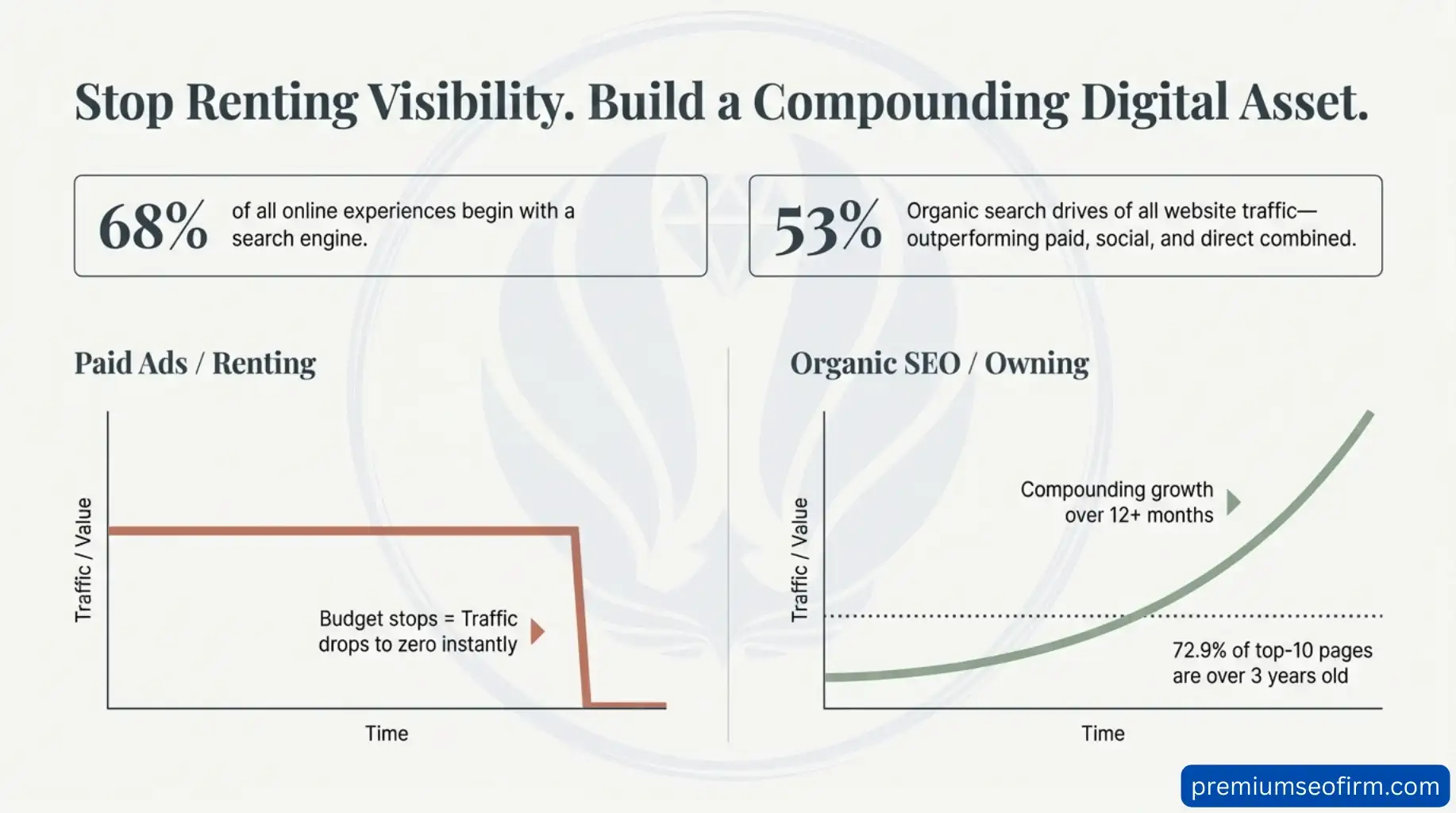
Organic search visitors carry active purchase intent at the moment of arrival — searchers queried the service before clicking the result. Search-before-click behavior produces higher conversion rates than outbound channels including cold calls and direct mail, per HubSpot’s inbound marketing research. The conversion differential reflects the structural difference between reaching a customer mid-task through organic search and interrupting a customer through unsolicited outbound messaging.
What Structural Advantages Do Small Businesses Hold in Google Search?
Small businesses hold 3 structural competitive advantages in search that large national brands cannot eliminate through budget alone — advantages rooted in geographic proximity weighting, topical specificity, and E-E-A-T Experience signals.
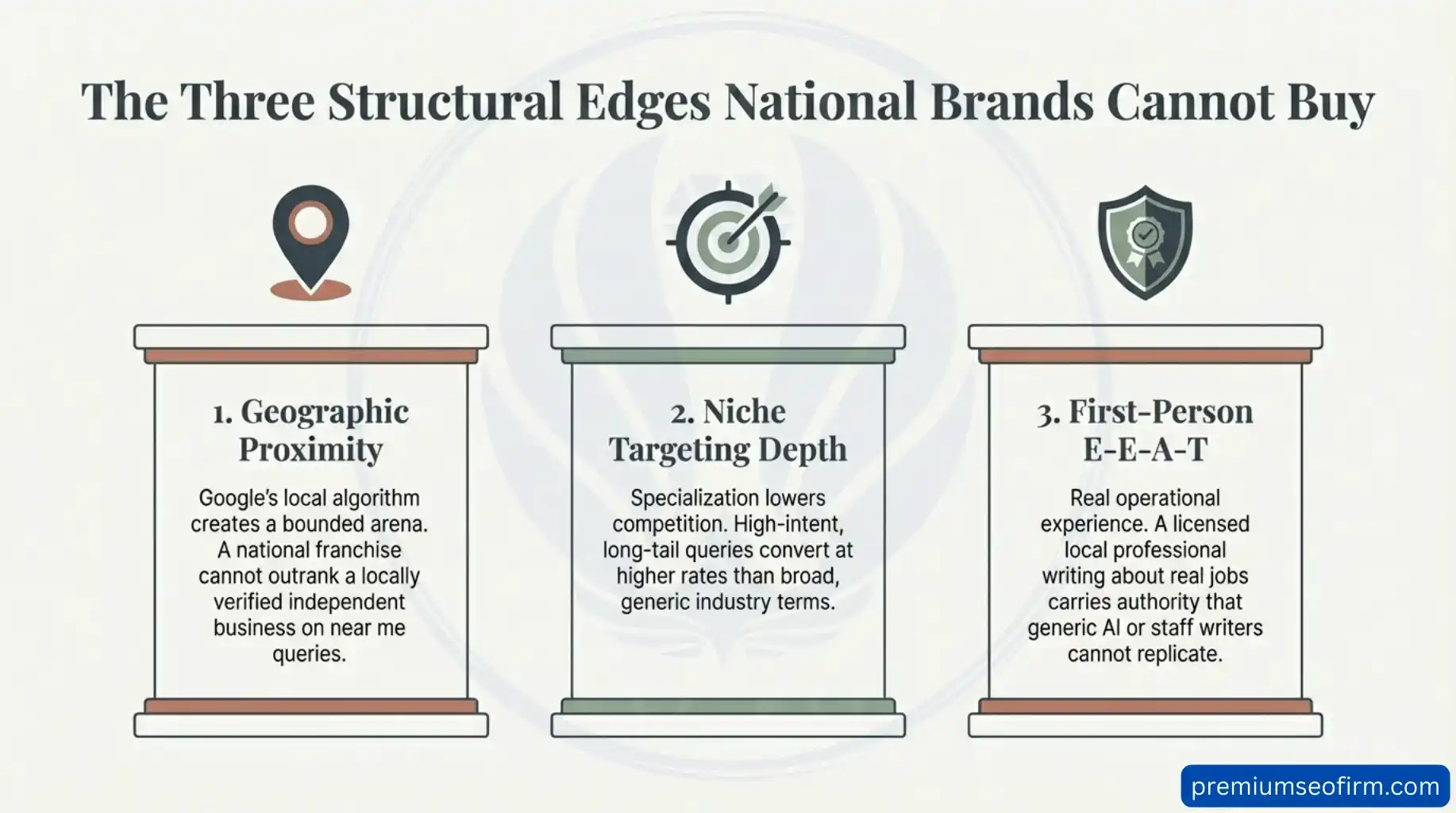
- Geographic proximity on local intent queries: Google’s local ranking algorithm weights proximity between the searcher and the business for queries with local intent. A national plumbing franchise cannot outrank a locally verified, locally reviewed independent plumber on a “plumber near me” query regardless of the franchise’s national domain authority. The local algorithm creates a geographically bounded competitive arena where a small business competes only against other businesses within its physical service area — not against every national brand in its category. This is the single most underused structural advantage available to small business SEO.
- Niche keyword targeting depth: A small business specializing in a narrow service niche faces meaningfully lower keyword competition than a generalist national brand competing across all queries in a category. A commercial refrigeration repair specialist for restaurants competes for “commercial refrigerator repair restaurant [city]” against a far smaller field than “refrigerator repair.” Niche queries convert at higher rates because searcher intent is more specific and purchase timing is more immediate. Small businesses earn first-page rankings for high-intent long-tail queries that large brands deprioritize due to low individual search volume.
- First-person Experience signals in E-E-A-T: Google’s E-E-A-T framework rewards content written by people with first-hand experience of the subject, per Google’s Search Quality Rater Guidelines (2024). A licensed electrician writing about electrical panel replacement carries first-person Experience authority that a national directory’s staff-written service description cannot replicate. This advantage compounds as AI-generated content increases at scale — original, first-person, experience-rich content becomes more differentiated as generic AI content becomes more prevalent.
Useful resource: How Bloggers Promote Newly Built Brand in 2026
What Is the Long-Term Return on Small Business SEO Investment?
The long-term return on SEO investment compounds through 3 documented mechanisms — authority accumulation, topical depth, and index expansion — at a rate structurally unavailable in paid advertising.
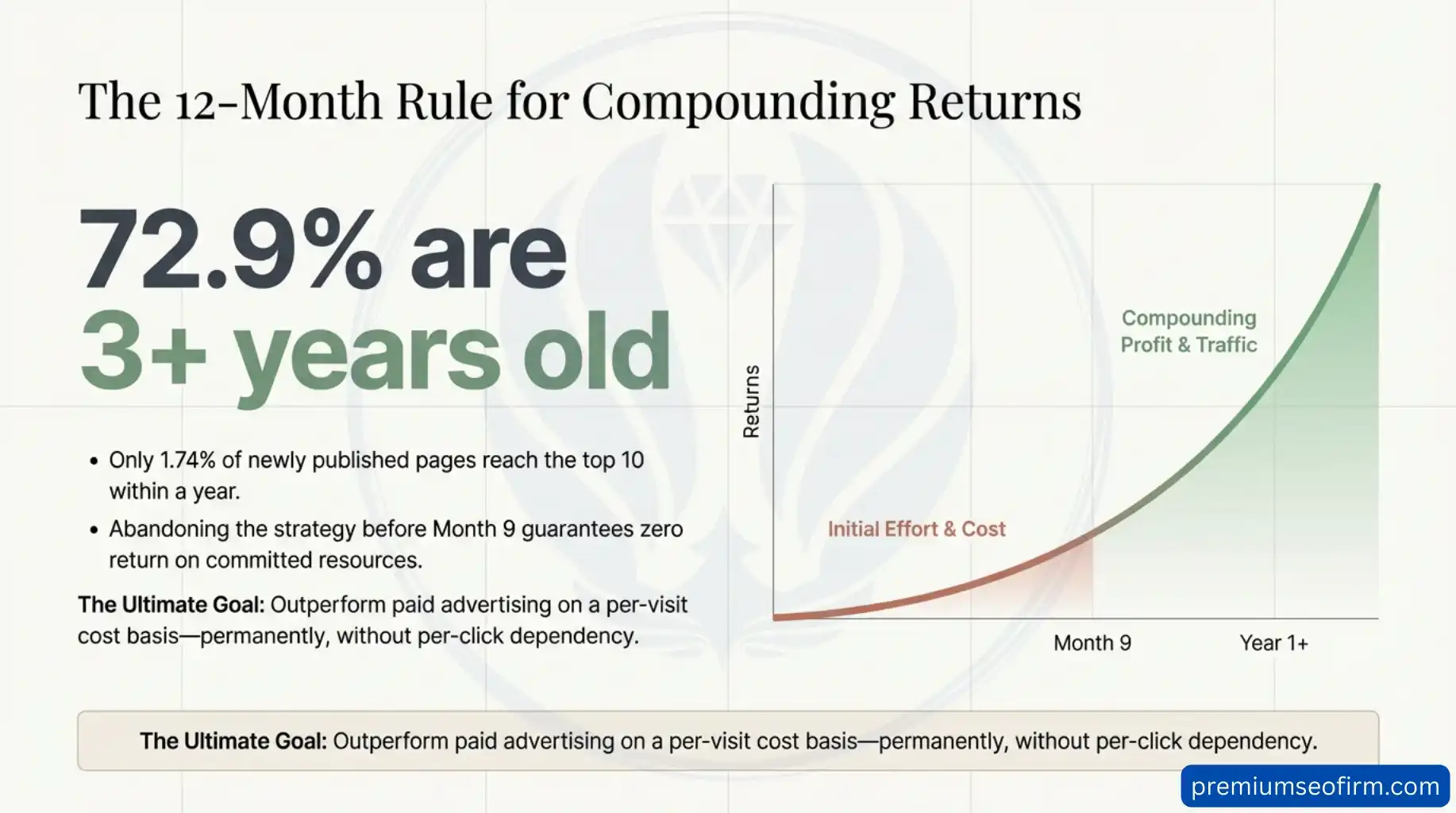
72.9% of pages ranking in Google’s top 10 are more than 3 years old, and only 1.74% of newly published pages reach the top 10 within a year, per Ahrefs’ Ranking Age Study (2025).
3 documented compounding mechanisms drive long-term SEO growth:
- Authority accumulation: Each new backlink acquired increases a domain’s Domain Rating (DR) — Ahrefs Pte. Ltd.’s link equity metric scored on a 0–100 logarithmic scale — simultaneously raising the ranking potential of every existing page on the domain, not only the specific page the backlink targets.
- Topical depth: Each new content page published within a focused topic cluster increases the domain’s topical authority score for that cluster, raising ranking positions for all related cluster pages — a single new page produces ranking improvements across the entire topic group.
- Index expansion: Each indexed page creates an additional organic entry point. A small business with 50 optimized, indexed pages holds 50 potential first-page rankings across 50 distinct keyword queries. A business with only a homepage holds 1.
3 financial comparisons quantify the compounding cost advantage of SEO over paid advertising:
- Cost per visit at 12 months: A small business spending $1,500/month on Google Ads receives approximately 1,500–3,000 visits/month at $0.50–$1.00 per click. A business investing $1,500/month in SEO for 12 months builds ranking pages generating traffic at zero marginal per-click cost after the investment period.
- Cost per visit over time: Paid advertising cost per visit remains constant or increases as competitive bid prices rise. SEO organic traffic volume grows as domain authority and indexed page count accumulate — cost per visit declines continuously as traffic expands without proportional budget increase.
- Traffic persistence: Paid advertising traffic ends within 24 hours of budget exhaustion. SEO-generated rankings persist for months to years without additional investment, provided competitors do not outinvest the business’s content and link portfolio during that period.
How Long Does Small Business SEO Take to Produce Measurable Results?
Small business SEO produces its first measurable ranking movements — defined as primary service keywords appearing in positions 11–30 in Google Search Console — within 4–6 months of Phase 1 and Phase 2 completion on domains with no prior SEO investment. First-page rankings for primary service keywords on domains entering competitive local markets from a zero-authority baseline require 12–18 months of consistent Phase 3 and Phase 4 investment. The benchmark data confirms this timeline: only 1.74% of newly published pages reach Google’s top 10 within a year, while 72.9% of pages currently ranking in the top 10 are more than 3 years old, per Ahrefs’ ranking age study.
3 timeline phases calibrate realistic SEO expectations for small business owners:
- Months 1–4 (Foundation and baseline establishment): The measurable output of this phase is indexation and impression growth — not ranking positions. Google Search Console’s Performance Report shows impression volume growing as Googlebot associates newly optimized pages with their target queries, even before first-page positions are achieved. GBP verification and citation building during this phase lay the Local 3-Pack eligibility foundation. Ranking position improvements during this phase are secondary to confirming that all technical blockers are resolved and all target pages are fully indexed.
- Months 4–9 (First ranking movements): Pages optimized during Phase 2 begin appearing in positions 11–30 for primary service keywords. Local 3-Pack appearances begin for lower-competition service area queries where GBP optimization has reached completion. Phase 3 content pages published during months 3–8 start generating impressions for long-tail keyword variations — confirming topical authority expansion is underway.
- Months 9–24+ (Compounding phase): First-page appearances for primary service keywords become consistent for domains with completed Phase 1–3 foundations and active Phase 4 link acquisition. At this stage, topical authority accumulation begins producing ranking improvements across multiple pages simultaneously — the compounding mechanism that distinguishes SEO’s long-term cost efficiency from paid advertising’s linear spend model. Domains that abandon investment before month 9 receive zero measurable revenue return regardless of Phase 1–2 quality, because compounding has not yet begun.
The 12-month minimum commitment threshold is directly supported by Ahrefs’ data: among the 1.74% of pages that do reach the top 10 within a year, 40.82% achieve it within the first month of publication — indicating fast-ranking pages are published on domains with pre-existing authority, not new zero-authority domains. New small business domains build that authority through the 4-phase sequence over 12–24 months.
How Does Google Crawl, Index, and Rank a Website?
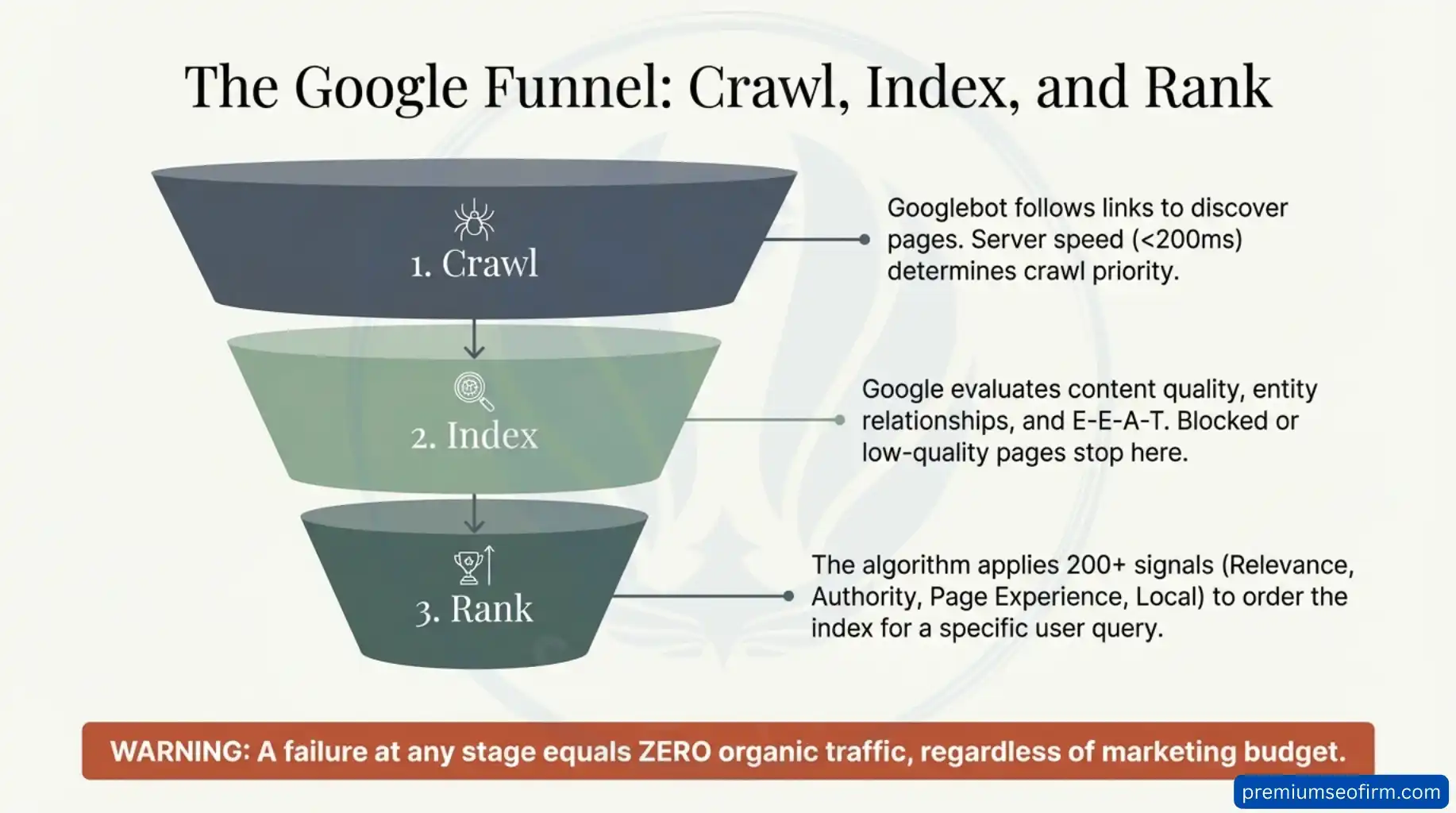
Google discovers, evaluates, and ranks web pages through a 3-stage sequential process — crawling, indexing, and ranking — where a website blocked at any stage receives zero organic search traffic regardless of content quality or marketing investment. Understanding each stage identifies the precise technical layer where small business visibility failures originate.
What Is Crawling and How Does Googlebot Discover Small Business Pages?
Crawling is the process by which Googlebot — Google LLC’s automated web-crawling software — systematically follows hyperlinks from known URLs to newly discovered URLs, mapping page content, heading structure, entity relationships, and link architecture across the web. Googlebot prioritizes discovered URLs based on 4 signals: page authority (inbound link quality and quantity), content freshness (recency of last modification date), crawl history (frequency of content changes on previous visits), and server response speed (time-to-first-byte performance).
Small business websites with server response times exceeding 200ms receive deprioritized crawl allocation compared to faster competitor sites, per Google Search Central’s Advanced Crawling Documentation (2024). Slow server response directly reduces how frequently Googlebot returns to recrawl updated pages — newly published content on slow servers takes longer to enter Google’s index.
3 primary mechanisms allow Googlebot to discover small business website pages:
- XML sitemaps — structured XML files listing all priority URLs on a domain, submitted through Google Search Console (Google LLC’s free webmaster diagnostic platform). XML sitemaps reduce discovery time for newly published pages from weeks to 1–4 days.
- Internal links — hyperlinks from one page of the website to another page on the same domain. Pages receiving zero internal links — classified as orphaned pages — receive significantly reduced Googlebot discovery probability and deprioritized crawl frequency.
- External backlinks — hyperlinks from other websites pointing to the small business domain. Googlebot follows external backlinks from already-crawled external domains to discover new domains and new URLs within known domains.
What Is Crawl Budget and How Does It Affect Small Business Websites?
Crawl budget is the total number of URLs Googlebot crawls on a domain within a defined time window — determined by crawl rate limit (the maximum crawl speed Googlebot applies to avoid overloading a server) and crawl demand (how frequently Google recrawls a URL based on its authority and update frequency), per Google Search Central’s Crawl Budget Documentation (2024). Small businesses with fewer than 200 indexed pages rarely face crawl budget issues. Crawl budget becomes worth optimizing when Google Search Console’s Coverage Report shows large numbers of “Discovered but not yet indexed” URLs alongside 4 common crawl budget drains:
- Product filter pages: E-commerce filter systems generate a unique URL for every filter combination. Googlebot crawls hundreds of near-duplicate filter pages instead of revisiting core service pages. Canonical tags pointing filter URLs to the main page, or parameter handling rules declared in Google Search Console’s URL Parameters Tool, resolve this drain.
- Session tracking URLs: Server configurations attaching unique session codes to every URL create an effectively unlimited number of duplicate page versions for Googlebot to parse. Excluding session codes from URLs at the server level resolves this drain.
- Thin tag archive pages: WordPress sites automatically generate an archive page for every post tag applied. A site with 50 tags generates 50 thin archive pages consuming crawl allocation that core content pages should receive. Adding a noindex directive to all tag archive pages — or consolidating to fewer than 10 core topic categories — eliminates this waste.
- Paginated thin pages: Paginated blog archives and search result pages with minimal content per page fragment crawl allocation across low-value URLs. Implementing rel=”next” and rel=”prev” pagination signals or consolidating paginated content behind a single canonical URL resolves this drain.
What Happens During the Indexing Stage?
Indexing is the process by which Google analyzes a crawled page’s content, extracts named entities and semantic relationships, evaluates content quality using E-E-A-T signals, and stores the page in Google’s Search Index — a database of hundreds of billions of web documents evaluated against every search query in real time. A page not stored in Google’s Search Index cannot rank for any query.
Google Search Console’s URL Inspection Tool reports indexation status across 4 categories: Indexed (confirmed in the index), Excluded by robots.txt or noindex directive (blocked by the site owner), Discovered but not yet indexed (URL found, crawl pending), and Crawled but not indexed (crawled and rejected due to quality assessment below minimum threshold). Pages in the fourth category require content quality improvement before Google adds the pages to the index.
How Does Google Determine Which Page Ranks for a Query?
Google determines ranking position using a machine learning-based algorithm evaluating 200+ confirmed signals, with E-E-A-T representing the overarching quality framework applied to every ranked page, as defined in Google’s Search Quality Rater Guidelines (December 2022 update, reinforced in 2024). 5 primary ranking signal categories determine small business page positions:
- Relevance signals — how closely a page’s content, entity coverage, and semantic structure match the specific intent of the user’s query, assessed by 4 Google NLP (Natural Language Processing) algorithms: RankBrain (Google LLC’s machine learning system for query interpretation), BERT (Google LLC’s bidirectional transformer for conversational queries), MUM (Google LLC’s multimodal understanding system for complex multi-part queries), and Neural Matching (Google LLC’s abstract concept-to-document matching system).
- Authority signals — the quality and relevance of backlinks pointing to the page and its domain. SEO practitioners estimate authority using 3 third-party metrics: Domain Rating (Ahrefs Pte. Ltd., scored 0–100 logarithmically), Domain Authority (MOZ Inc., scored 1–100), and Trust Flow (Majestic, scored 0–100). Note: Domain Rating, Domain Authority, and Trust Flow are practitioner estimation tools — Google does not use these metrics directly in its ranking algorithm.
- Page experience signals — Core Web Vitals scores (LCP, CLS, INP), mobile usability compliance, HTTPS security implementation, and absence of intrusive interstitials obstructing content access.
- Content quality signals — E-E-A-T evaluation across all 4 dimensions, information gain score (uniqueness of content above competing pages), topical completeness, factual accuracy, and evidence attribution density.
- Local relevance signals — Google Business Profile (Google LLC’s free business listing platform) completeness and verification status, NAP (Name, Address, Phone) citation consistency across local directories, and geographic proximity between the searcher’s location and the business’s service area.
What Does E-E-A-T Mean in Practice for Small Business Websites?
E-E-A-T (Experience, Expertise, Authoritativeness, and Trustworthiness) is Google’s overarching content quality framework used by human Quality Raters to evaluate whether a page demonstrates the credentials, first-hand experience, and reliability appropriate to its subject matter, as defined in Google’s Search Quality Rater Guidelines. Quality Rater evaluations train the machine learning systems that determine rankings — E-E-A-T functions as a directional quality framework rather than a checkbox checklist.
4 practical E-E-A-T implementation requirements for small businesses:
- Experience — demonstrates first-hand involvement with the subject. Service businesses demonstrate Experience by publishing content documenting real jobs completed, real problems encountered, and real solutions applied — not generic descriptions available on any competitor site. A licensed roofer writing “3 flat roof drainage failures we correct on commercial buildings in [city] every spring” carries Experience signals that a generic “types of roof problems” article cannot replicate. Before-and-after job photos, completion certificates, and project-specific details signal Experience to both Google’s systems and readers simultaneously.
- Expertise — demonstrates domain knowledge credentials. For regulated professions including legal, medical, financial, electrical, and HVAC, displaying professional licenses, certifications, association memberships, and years of active practice directly on service pages adds Expertise signals. Author bylines on blog content link to a dedicated author page listing credentials, published work, and professional background. Google’s Quality Rater Guidelines specifically identify author credential pages as an Expertise signal for YMYL (Your Money or Your Life) topic categories.
- Authoritativeness — demonstrates that external authoritative sources recognize the business as a credible voice in its field. Backlinks from industry associations, local news coverage, verified third-party review platforms, and supplier partner pages all contribute Authoritativeness signals. A plumbing business cited in a local newspaper article about winter pipe freeze events carries stronger Authoritativeness than an equivalent business with no external recognition — the external citation functions as third-party endorsement that Google’s Quality Rater Guidelines explicitly reference.
- Trustworthiness — demonstrates that the business, website, and content are reliable. Trustworthiness signals include 7 documented indicators: verified Google Business Profile, consistent NAP data, HTTPS encryption on all pages, visible business address and phone number on the contact page, privacy policy and terms of service pages, transparent pricing disclosure, and active review response management. Google’s Quality Rater Guidelines identify the absence of a clear responsible party as a characteristic of “Lowest quality” pages.
What Are the Six Core Disciplines of Small Business SEO?
Small business SEO encompasses 6 interdependent disciplines — on-page SEO, technical SEO, local SEO, off-page SEO, content SEO, and analytics — that function as a single integrated ranking system where each discipline amplifies the effectiveness of the remaining 5 when implemented correctly.
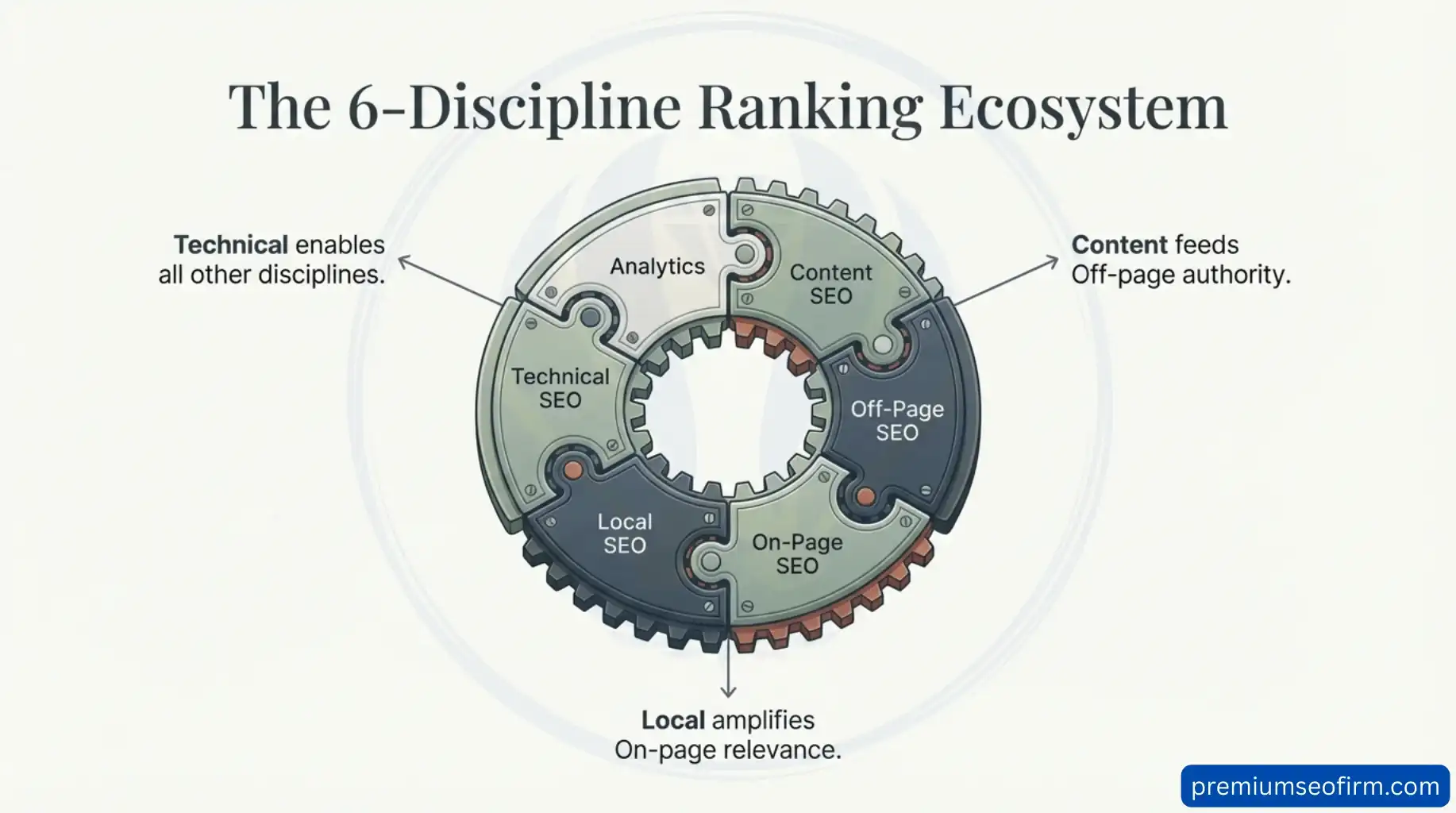
3 documented structural relationships connect these disciplines:
- Technical SEO enables all other disciplines: A website with crawl errors, failing Core Web Vitals scores, or indexation blocks cannot benefit from content investment or link building. Googlebot cannot rank content Googlebot cannot access and evaluate. Technical SEO is the prerequisite layer for all other SEO investment.
- Content SEO feeds off-page SEO: High-quality, original content pages generate significantly more inbound backlinks than low-quality pages covering the same topic, per Ahrefs’ 2024 Link Acquisition Research. Off-page authority is a downstream outcome of content quality investment, not a parallel track.
- Local SEO amplifies on-page SEO for service businesses: Google Business Profile optimization produces Local 3-Pack ranking improvements that on-page optimization alone cannot achieve. A plumbing business ranking in position 8 for “plumber near me” advances to the Local 3-Pack through Google Business Profile optimization and citation building — not through additional title tag changes.
How Does On-Page SEO Affect Search Rankings?
On-page SEO directly controls a page’s topical relevance signals by optimizing 12 confirmed HTML and content elements that Google evaluates during indexation and ranking. Pages ranking in Google’s top 3 positions for competitive keywords satisfy all 12 on-page elements at a higher rate than pages in positions 7–10, per Semrush’s 2024 Ranking Factors Study of 500,000 URLs. On-page optimization represents the highest-return activity for small business pages during Phase 2 of the SEO implementation sequence.
What On-Page HTML Elements Does Google Evaluate?
Google evaluates 12 primary on-page SEO elements that collectively determine a page’s topical relevance score for its target keyword cluster. The 12 elements are:
- Title tag — the HTML
<title>element displayed as the clickable headline in Google’s search results. Title tags of 50–60 characters with the primary keyword in the first 30 characters achieve higher CTR than equivalent title tags placing the keyword in the final 30 characters, per Backlinko’s 2024 CTR Study of 4 million search results. - Meta description — the HTML
<meta name="description">element displayed as the descriptive snippet beneath the title tag. Meta descriptions do not directly influence ranking position. Meta descriptions directly control CTR — a 2% CTR improvement across 500 indexed pages compounds into measurable traffic gains within 60–90 days. - H1 heading — the primary heading declaring the page’s macro topic. Each page requires exactly 1 H1 containing the primary target keyword.
- H2 and H3 headings — sub-topic headings signaling topical structure to Google’s document understanding systems. Question-format H2 headings increase Featured Snippet, People Also Ask box, and AI Overview citation eligibility, per Semrush’s 2024 Snippet Optimization Study.
- Body content — the main text evaluated for named entity density, topical completeness, factual accuracy, and information gain above competing pages on the same topic.
- Internal links — hyperlinks to related pages on the same domain using keyword-matched anchor text aligned to the target page’s H1 keyword phrase.
- Image alt attributes — descriptive text attributes on
<img>elements used by Googlebot for image content understanding and by Google Image Search for image ranking. - URL structure — the page’s web address, which ranks best when containing the primary keyword and using hyphens as word separators with no stop words.
- Structured data — JSON-LD (JavaScript Object Notation for Linked Data) schema markup declaring content type, author identity, publication date, and entity relationships — enabling rich result eligibility for 29 Google-supported schema types including LocalBusiness, Service, FAQ, HowTo, and Article.
- Core Web Vitals scores — Largest Contentful Paint (LCP), Cumulative Layout Shift (CLS), and Interaction to Next Paint (INP) — confirmed ranking signals within Google’s page experience algorithm.
- Mobile usability — the page’s functional rendering on mobile devices, evaluated by Google’s mobile-first indexing system. Universal mobile-first indexing completed in late 2023.
- Canonical tags — HTML elements (
rel="canonical") declaring the preferred URL version when duplicate or near-duplicate page versions exist, consolidating PageRank equity and link authority to a single authoritative URL.
What Is Search Intent and How Does It Determine Content Format?
Search intent is the underlying goal a user seeks to accomplish when entering a specific query — classified into 4 intent categories, each requiring a distinct page format to satisfy Google’s ranking algorithm and convert the visitor.
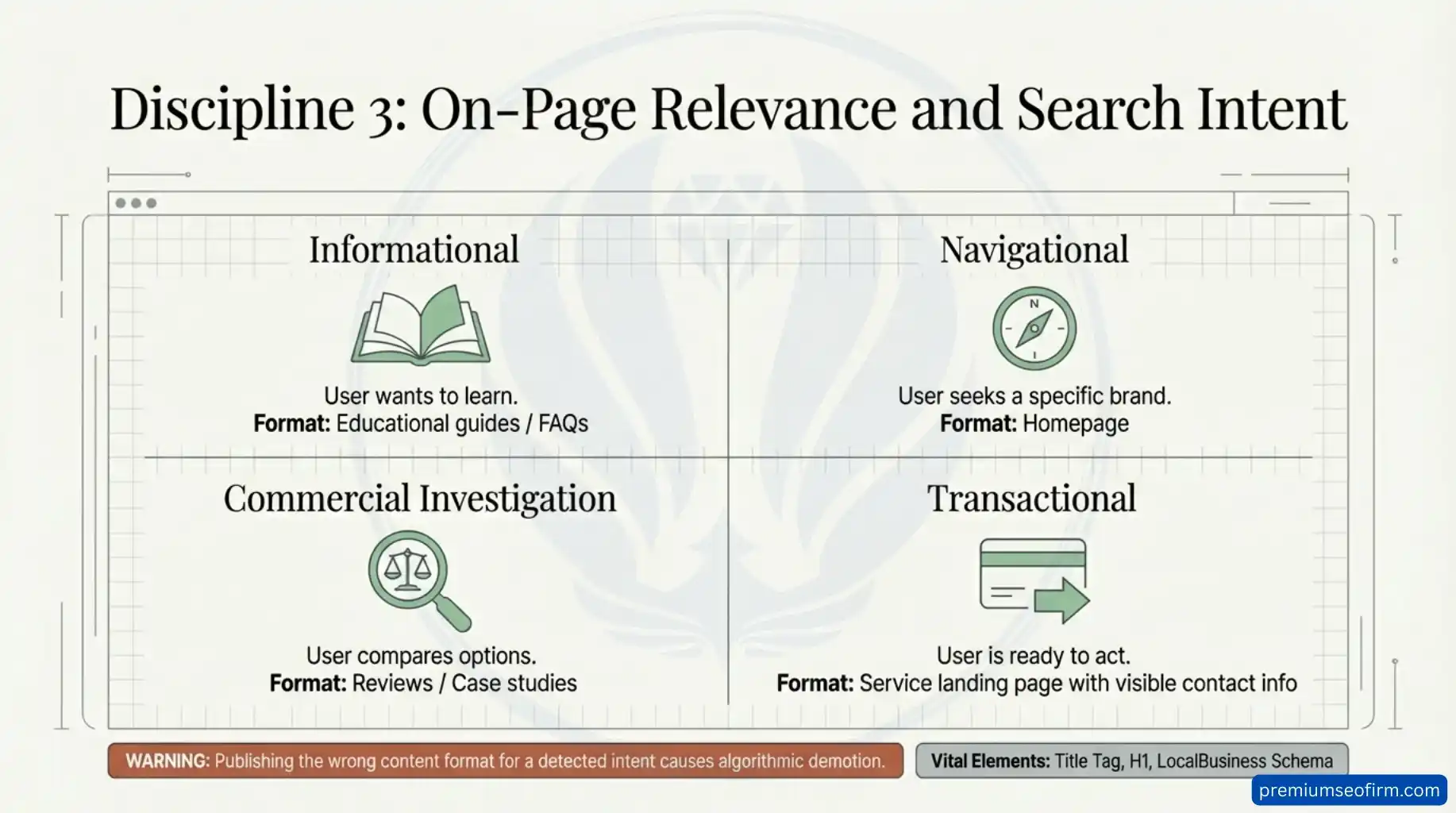
Publishing the wrong content format for a detected intent creates a structural mismatch that Google’s algorithm corrects by demoting the page, regardless of keyword presence, backlink count, or on-page optimization quality.
4 search intent categories and their required content formats for small business service pages:
- Informational intent — the user seeks to learn or understand. Query examples: “how does pipe relining work,” “what causes low water pressure,” “signs you need a roof inspection.” Format required: educational guide, explainer article, or FAQ page — not a service landing page with a contact form. Small businesses correctly matching informational blog posts to informational queries build topical authority and capture potential customers at the research stage, before they are ready to transact. Structuring informational content with question H2 headings and direct-answer opening paragraphs maximizes eligibility for AI Overview and Featured Snippet sourcing.
- Navigational intent — the user seeks a specific website or brand. Query examples: “[business name] reviews,” “[business name] contact number,” “[business name] opening hours.” Format required: homepage or branded information page optimized for the business name. A small business whose homepage does not rank first for its own brand name has a GBP verification, brand name consistency, or technical SEO issue requiring resolution before any other optimization work proceeds.
- Commercial investigation intent — the user compares options before deciding. Query examples: “best plumber in [city],” “plumbing company reviews [neighborhood],” “flat rate vs. hourly plumber.” Format required: comparison page, review-rich service page, or case study demonstrating competitive differentiators. Commercial investigation queries are high-intent pre-purchase signals — users actively evaluate whether to contact the business.
- Transactional intent — the user is ready to take action. Query examples: “emergency plumber [city] available now,” “book roof inspection [city],” “[service] quote [location].” Format required: service landing page with a visible phone number, online booking option, or inquiry form above the fold, and trust signals (reviews, license number, years in business) within the first screen. A page in position 1 for a transactional query that buries the contact mechanism below 800 words of body text loses the conversion despite winning the click.
How Do Title Tags and Meta Descriptions Affect Click-Through Rate?
Title tags and meta descriptions control organic CTR — the percentage of search users who click a result after seeing it — with title tag optimization producing CTR improvements across all positions, per Ahrefs’ 2024 CTR Optimization Study of 4 million pages. The #1 result in Google’s organic search results achieves an average CTR of 27.6% — 10x more likely to receive a click than a page in the #10 position. Moving up 1 position increases CTR by an average of 2.8%, per Backlinko’s 2024 CTR Analysis of 4 million search results. This effect is strongest moving from position #3 to position #2 and weakest at positions 8–10, where CTR rates are virtually identical.
Google AI Overviews now appear for approximately 47–48% of tracked queries in the United States, up from roughly 30% one year prior, per BrightEdge’s February 2026 Analysis — suppressing organic CTR across affected query sets below these historical benchmarks. This CTR suppression effect is strongest on informational queries and weakest on transactional and local queries.
What Is the Role of Heading Hierarchy in On-Page SEO?
Heading hierarchy structures a page’s topical organization for Google’s NLP systems and enables extraction of individual heading-and-answer pairs for Featured Snippets, People Also Ask boxes, and AI Overview citations — the 3 SERP feature formats appearing above standard organic results that generate disproportionate click share. Queries that trigger AI Overviews tend to be longer and more specific than queries that do not, indicating Google favors predictable, fact-based questions where a consensus answer can be confidently summarized, per Semrush’s 2025 AI Overviews Study. Content structured with question-format H2 headings and direct answer paragraphs of 40 words or fewer maximizes eligibility for both Featured Snippet extraction and AI Overview sourcing simultaneously.
How Does Structured Data Help Small Businesses Earn Rich Results in Google Search?
Structured data — JSON-LD (JavaScript Object Notation for Linked Data) schema markup declared in the <head> element of each page — communicates page entity type, entity attributes, and relationships to Googlebot in a machine-readable format, enabling eligibility for rich results that display additional information alongside standard organic listings and increase CTR independently of ranking position changes.
3 schema markup types produce the highest direct impact for small business service pages in 2026:
- LocalBusiness schema — declares the business entity’s name, address, phone number, geographic coordinates, operating hours, price range, and payment methods in structured data. LocalBusiness schema strengthens entity associations in Google’s Knowledge Graph, supports Knowledge Panel display for branded searches, and provides structured confirmation of NAP data that reinforces citation consistency signals. Schema.org defines specific subtypes of LocalBusiness — including Plumber, Dentist, LegalService, HomeAndConstructionBusiness, and Restaurant — and selecting the most specific applicable subtype produces stronger entity classification than declaring only the generic LocalBusiness parent type.
- AggregateRating schema — declares the business’s aggregate star rating and verified review count, enabling star rating display alongside the organic listing in search results. A position 4 result displaying a 4.8-star aggregate rating alongside 240 verified reviews reliably achieves higher CTR than a position 2 result with no rating display for commercial investigation queries — the rich snippet increases perceived credibility before the user reaches the page. AggregateRating schema requires underlying ratings to be genuine reviews from real customers sourced from a platform the business controls or aggregates — fabricated ratings violate Google’s structured data policies and trigger manual review actions.
- FAQ schema — declares question-and-answer pairs structured in the
mainEntityproperty of the page’s schema markup. Since August 2023, Google limited expanded FAQ rich result display in SERPs to authoritative government and health information sources. For small business service pages, FAQ schema implementation no longer reliably triggers visual FAQ expansion in organic results — its current value is entity signal completeness (the structured Q&A pairs contribute to Knowledge Graph entity associations) and AI Overview citation eligibility (question-answer structure directly matches the extraction format AI Overview systems prefer).
Google’s Rich Results Test (Google LLC’s free structured data validation tool, accessible at search.google.com/test/rich-results) validates schema markup accuracy for any URL and reports eligibility for every rich result type Google currently supports. Running the Rich Results Test before and after structured data implementation confirms correct deployment before the pages are re-crawled.
What Role Does Technical SEO Play for Small Business Sites?
Technical SEO ensures Googlebot discovers, crawls, renders, and indexes all high-priority pages on a small business website — without a functional technical foundation, no other SEO discipline produces its intended ranking improvements regardless of content quality, backlink count, or local optimization investment. Small business websites with unresolved critical crawl errors consistently show measurably lower indexed page counts than technically healthy competitor sites, based on enterprise site audit data from Screaming Frog Ltd. Resolving crawl errors restores Googlebot access to de-indexed pages within 1–14 days of fix implementation, per Google Search Console Coverage Report Documentation (2024).
How Does Site Speed Affect Small Business Search Rankings?
Site speed directly affects both Core Web Vitals ranking signals and user conversion behavior — pages loading in under 1 second achieve a 32% higher conversion rate than pages loading in 3 seconds, per Google’s Mobile Page Speed Benchmark Research. Pages loading in 5 seconds show a 106% higher bounce rate than pages loading in 1 second, per the same research. For small businesses where each inbound phone call or form submission represents direct revenue, the conversion rate differential carries measurable financial consequences.
3 primary technical factors control small business site speed:
- Image optimization — the highest-impact lever for most small business websites with no prior technical optimization, per HTTP Archive Web Almanac Data (2025). Converting images to WebP format and implementing lazy loading reduces file sizes by 25–35% compared to equivalent compressed JPEGs, per Google’s PageSpeed Insights Documentation. Most WordPress performance plugins handle WebP conversion and lazy loading automatically without requiring custom development.
- Server response time — Time to First Byte (TTFB) under 200ms satisfies Google’s recommended server responsiveness threshold. Most small businesses on shared hosting plans produce TTFB above 500ms. Upgrading to VPS hosting or managed WordPress hosting reduces TTFB to sub-200ms on most configurations — a hosting plan change requiring no code modifications from the business owner.
- JavaScript deferral — deferring non-critical JavaScript execution reduces Interaction to Next Paint (INP) scores by preventing non-critical scripts from blocking the page before it is visible to the user. JavaScript deferral eliminates long tasks — JavaScript execution blocks exceeding 50ms — from the browser’s main thread during page load.
What Are Core Web Vitals and Why Do They Affect Small Business Rankings?
Core Web Vitals are 3 Google-defined page performance metrics — Largest Contentful Paint (LCP), Cumulative Layout Shift (CLS), and Interaction to Next Paint (INP) — that function as confirmed ranking signals within Google’s page experience algorithm. INP replaced First Input Delay (FID) as the third Core Web Vital in March 2024. Pages meeting all 3 “Good” thresholds rank above pages failing all 3 metrics, per Google’s Core Web Vitals Field Data Analysis (2025).
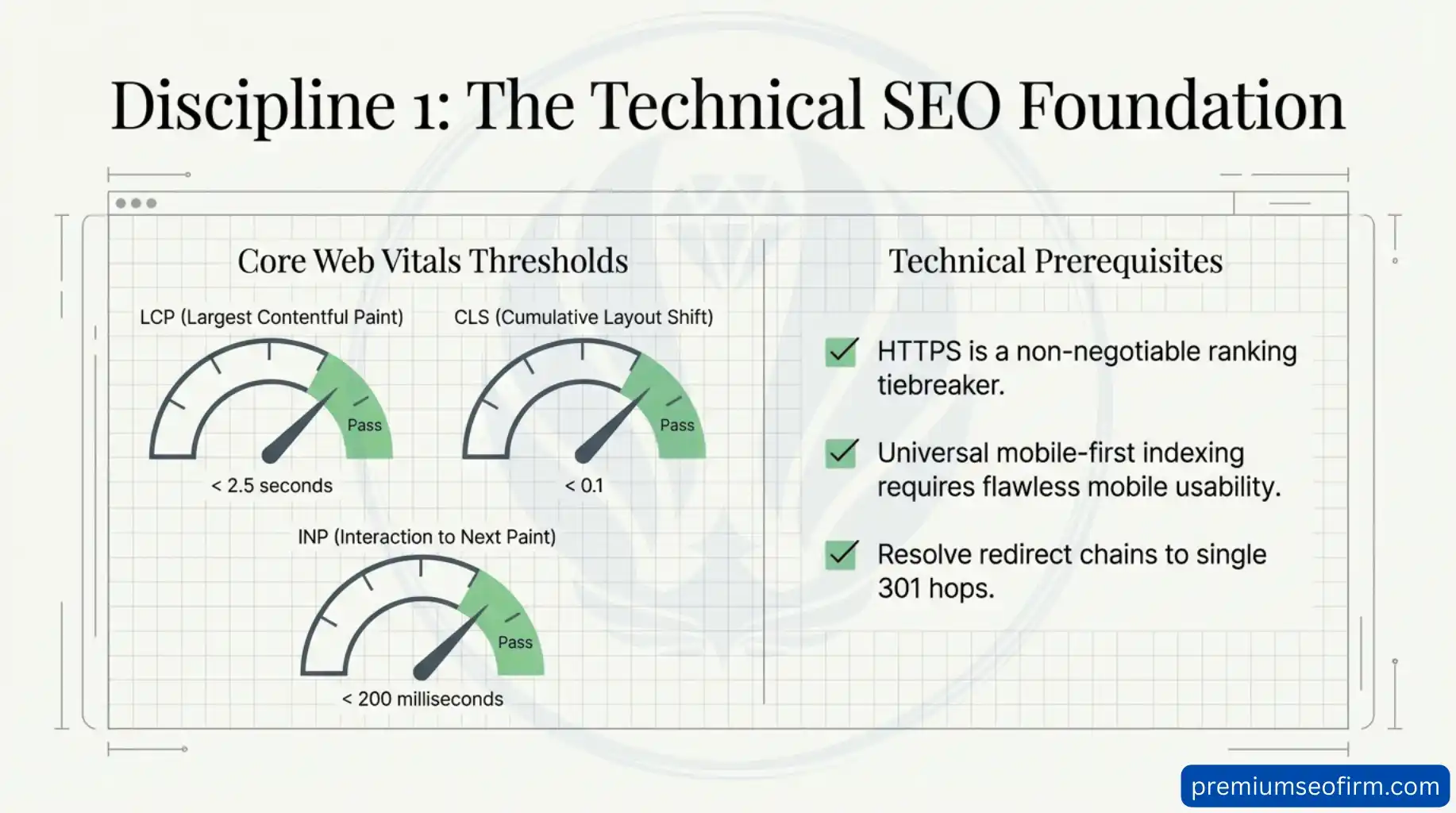
The 3 metrics and their confirmed “Good” thresholds are:
- LCP (Largest Contentful Paint) — measures how quickly the largest visible content element loads. Good threshold: under 2.5 seconds. The largest element is typically a hero image or above-the-fold heading. Optimizing the hero image and improving server response time are the 2 most direct LCP improvement levers.
- CLS (Cumulative Layout Shift) — measures how much page elements shift unexpectedly during loading. Good threshold: under 0.1. The most common CLS failure cause is images and embeds without declared dimensions — adding explicit width and height attributes to all images resolves most CLS failures.
- INP (Interaction to Next Paint) — measures the delay between a user’s tap or click and the browser’s next visual response. Good threshold: under 200 milliseconds. High INP scores result from heavy JavaScript execution blocking the main browser thread — JavaScript deferral and script optimization resolve most INP failures.
Google PageSpeed Insights (Google LLC’s free page performance diagnostic tool) measures Core Web Vitals for any URL using both lab data (controlled simulation) and field data (real user measurement from the Chrome User Experience Report). Google Search Console’s Core Web Vitals Report identifies all pages on a domain failing one or more thresholds, organized by failure type.
How Does Mobile Usability Affect Technical SEO for Small Businesses?
Mobile usability determines whether a page qualifies for full ranking consideration under Google’s mobile-first indexing system — Google’s default mode of crawling and ranking all pages based on the mobile version of each URL, with universal mobile-first indexing completed in late 2023. 63% of all Google searches originate from mobile devices, per Statcounter’s Q4 2025 Data. Pages with mobile usability failures rank below mobile-optimized equivalents regardless of desktop performance quality.
4 common mobile usability failures that suppress small business rankings are:
- Text below 16px font size triggers mobile usability errors in Google Search Console and causes users to abandon the page before reading content.
- Buttons and links spaced fewer than 48px apart cause accidental taps and increase bounce rates on service pages.
- Content wider than the viewport forces horizontal scrolling, which Google treats as a functional usability failure on mobile.
- Intrusive pop-ups appearing within the first 3 seconds of page load trigger Google’s intrusive interstitial penalty.
Google Search Console’s Mobile Usability Report identifies all 4 issue types by page URL, making accurate diagnosis straightforward before remediation begins.
Why Is HTTPS a Non-Negotiable Technical SEO Requirement?
HTTPS (HyperText Transfer Protocol Secure) encrypts data transmitted between the user’s browser and the web server and functions as a confirmed Google ranking tiebreaker signal, confirmed in 2014, per Google Search Central’s HTTPS as a Ranking Signal Documentation. In 2026, every major browser displays a “Not Secure” warning on HTTP pages. When all other ranking factors are equal between an HTTPS and an HTTP page, Google ranks the HTTPS page higher.
4 documented technical consequences of operating an HTTP small business website:
- Browser security warnings deter form completions — HTTP pages trigger address bar warnings that directly reduce form submission rates on contact, booking, and quote request pages, regardless of how well the page ranks.
- HTTPS functions as a confirmed ranking tiebreaker — in competitive local keyword sets where position differences between rank 4 and rank 6 are marginal across multiple signals, HTTPS compliance eliminates one negative variable.
- Referral traffic misattributes as direct traffic — backlinks from HTTPS sites to HTTP pages lose referral source attribution in Google Analytics 4 (Google LLC’s free website analytics platform, replacing Universal Analytics as of July 2023). Misattributed referral visits obscure the measured value of link-building activity in acquisition reports.
- Google Search Console splits HTTP and HTTPS into separate properties — migrating to HTTPS without configuring the HTTPS property in Google Search Console creates reporting blind spots that make accurate SEO performance measurement impossible.
How Do Redirect Chains Reduce Small Business SEO Performance?
A redirect chain occurs when URL A redirects to URL B, which then redirects to URL C — forcing Googlebot to follow multiple sequential hops before reaching the final destination URL, reducing the PageRank equity transferred with each additional redirect step, per Google’s Crawling Best Practices Documentation. 3 common redirect chain causes on small business websites are: HTTPS migrations where HTTP URLs redirect to an intermediate URL before reaching the final HTTPS version; domain migrations where an old domain redirects through a staging URL before reaching the new domain; and URL restructuring where old paths redirect through outdated subfolder structures before reaching final clean URLs.
Screaming Frog SEO Spider (technical SEO crawling tool developed by Screaming Frog Ltd., first released in 2010) identifies all redirect chains in a single crawl, reporting chain length and final destination URL for every affected page. The resolution for all 3 causes is identical: implement direct single-hop 301 redirects from every old URL to its final destination, eliminating all intermediate redirect steps.
How Does Local SEO Help Service Businesses Get Found?
Local SEO positions a small business’s website and Google Business Profile in Google’s location-based search results — including the Local 3-Pack, the 3-business block displayed above organic results for geographic queries — for searches with local intent representing approximately 46% of all Google searches, per industry estimates referenced across Google’s local search documentation. 42% of searchers click on Google Map Pack results for local queries, per Backlinko’s 2024 Research. Businesses absent from the Local 3-Pack compete for a structurally smaller share of total local search traffic — note that paid Local Service Ads frequently appear above the Local 3-Pack in competitive markets.
What Is Google Business Profile and Why Is It the Highest-Priority Local SEO Element?
Google Business Profile (GBP) is Google LLC’s free business listing platform controlling a small business’s appearance across Google Maps, the Local 3-Pack, and the Knowledge Panel displayed when users search the business name directly — and represents the single highest-impact local SEO element for service businesses with a physical location or defined geographic service area.
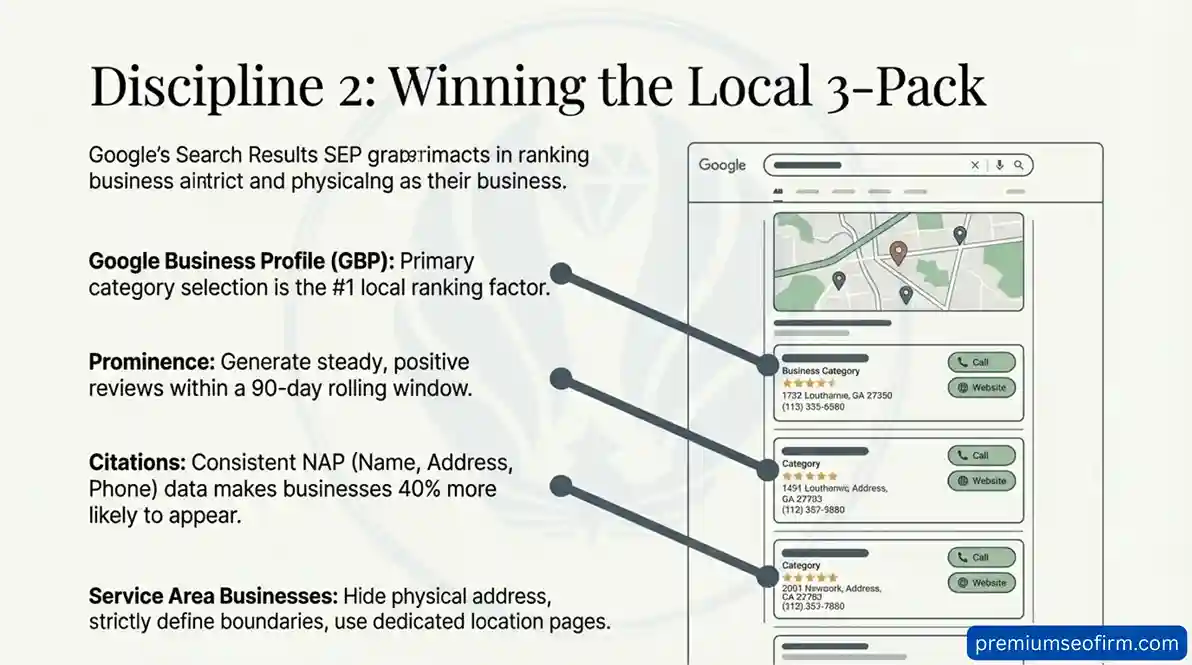
An unverified GBP listing removes a business from Local 3-Pack eligibility entirely for its service area — a quantifiable daily revenue cost regardless of how strong the business’s organic rankings are.
3 GBP elements produce the highest Local 3-Pack ranking improvements when optimized, per Whitespark’s 2026 Local Search Ranking Factors Survey as reported by BrightLocal:
- Primary business category selection — the single most important Local Pack ranking factor. The primary category declared in the Google Business Profile directly determines which local queries trigger the listing. Selecting the most specific accurate primary category (for example, “Emergency Plumber” rather than “Plumber”) produces the strongest query-level relevance match for high-intent searches.
- Review volume, positive rating, and review recency — the second most important Local Pack ranking factor. Businesses generating a steady volume of positive reviews published within the past 90 days rank above competitors with lower review counts or older review histories for equivalent queries in the same service area.
- Consistent NAP data across citation sources — businesses with consistent Name, Address, and Phone data across major citation sources are 40% more likely to appear in the Local Pack than businesses with inconsistent NAP data, per Whitespark’s 2026 Local Search Ranking Factors Survey as reported by BrightLocal.
What Are Local Citations and How Do They Affect Local Rankings?
Local citations are structured business Name, Address, and Phone number (NAP) mentions across online directories, data aggregators, and review platforms — functioning as a confirmatory authority signal that strengthens Google’s confidence in a business’s existence, location, and legitimacy. Citation consistency across major sources accounts for 9% of overall local ranking importance when averaged across Local Pack, local organic, and AI search visibility, per Whitespark’s 2026 Local Search Ranking Factors Survey as reported by BrightLocal.
Priority citation sources for small service businesses include 7 confirmed platforms: Google Business Profile (primary), Apple Maps (Apple Inc.), Bing Places (Microsoft Corporation), Yelp (Yelp Inc.), Yellow Pages (Thryv Holdings Inc.), Angi (Angi Inc., majority controlled by IAC/InterActiveCorp), and industry-specific directories relevant to the business’s service category. NAP inconsistencies across citation sources — including address abbreviation differences (“St.” vs. “Street”), phone number format variations, and outdated suite numbers — create conflicting entity data in Google’s Knowledge Graph, reducing Local Pack eligibility.
What Are the Key Local Ranking Factors for Small Business Service Pages?
Google’s local ranking algorithm evaluates 3 primary factors — Relevance, Distance, and Prominence — that together determine Local 3-Pack position for every geographic search query, as defined in Google’s How Google Determines Local Ranking Documentation (2024). 5 confirmed local ranking signals operate within Google’s 3-factor model:
- Primary GBP category (Relevance) — the single most important Local Pack ranking factor, per Whitespark’s 2026 survey. Accurate, specific category selection determines query eligibility for the listing.
- Keyword presence in GBP description and service entries (Relevance) — service keywords in the business description and individual GBP service entries increase query matching precision for high-intent searches.
- Review count, average star rating, and review recency (Prominence) — reviews received within the last 90 days signal active customer engagement to Google’s local ranking algorithm.
- Citation volume and NAP consistency (Prominence) — consistent NAP data makes businesses 40% more likely to appear in the Local Pack, with citations accounting for 9% of overall local ranking importance, per Whitespark’s 2026 survey via BrightLocal.
- On-page local optimization of the website (Relevance) — service area pages targeting “[service] + [city]” keyword combinations with LocalBusiness schema markup declaring the business’s physical address, phone, and service area boundaries.
How Does Local SEO Differ for Service Area Businesses vs. Brick-and-Mortar Locations?
Service area businesses (SABs) — businesses traveling to customers rather than receiving customers at a fixed address, including plumbers, electricians, HVAC technicians, landscapers, and home cleaning services — operate under distinct Google Business Profile rules from brick-and-mortar businesses, per Google’s Business Profile Help Documentation for Service Area Businesses. 4 key operational differences in GBP management for service area businesses:
- Address visibility: SABs hide their physical address on Google Maps while maintaining a verified GBP listing. Hiding the address does not disqualify the listing from Local 3-Pack eligibility — proximity signals are calculated from declared service area boundaries, not the hidden physical address.
- Service area declaration precision: SABs define geographic service area boundaries within GBP using city, ZIP code, or region designations. Declaring a service area too broad relative to actual operating radius dilutes proximity relevance — a plumber declaring a 200-mile service area when primarily serving a single city competes in a larger geographic pool and ranks lower for city-specific queries than a competitor with a correctly declared tight service area.
- Citation address consistency: SABs must ensure citations across all directories either consistently exclude the physical address or consistently represent the service area. Inconsistent citation data — some directories showing the home address, others showing no address, others showing a virtual office address — creates conflicting entity data in Google’s Knowledge Graph and suppresses Local Pack eligibility.
- Dedicated service area landing pages: Unlike brick-and-mortar businesses creating a single location-optimized service page, SABs serving multiple cities require dedicated service area landing pages for each primary city served, each targeting “[service] + [city]” with substantively distinct locally relevant content. Google’s Helpful Content System suppresses SAB location pages containing only a city name swapped into an otherwise identical template — each page requires locally differentiated content including neighborhood references, area-specific service history, and locally relevant FAQs.
How Does Off-Page SEO Build Authority for Small Businesses?
Off-page SEO builds domain authority through backlinks — hyperlinks from external websites pointing to the small business domain — which transfer PageRank equity and topical relevance signals from the linking domain to the receiving page. Pages ranking in Google’s top 3 positions hold significantly more backlinks on average than pages in positions 4–10 for the same keyword, per Ahrefs’ Link Correlation Research (2024). Each backlink functions as a third-party endorsement whose ranking impact is determined by 4 quality factors.
What Makes a Backlink Valuable for Small Business SEO?
Backlink value is determined by 4 factors: linking domain authority, topical relevance between the linking domain and the linked page, link placement within the page, and the link’s follow attribute — a single high-authority, topically relevant, editorially placed dofollow link outperforms dozens of low-authority, unrelated links. The 4 factors in detail:
- Linking domain authority — a single backlink from a domain with a Domain Rating of 70+ produces a stronger ranking signal than 50 backlinks from domains with Domain Ratings below 20, per Ahrefs’ 2024 Link Quality Correlation Study. Quality of referring domains outweighs quantity for all keyword difficulty levels above 30.
- Topical relevance — backlinks from domains operating in the same industry or topic category transfer stronger relevance signals than backlinks from unrelated domains. A local plumber receiving a backlink from a plumbing trade association gains both authority transfer and topical alignment simultaneously — two distinct positive ranking signals.
- Link placement — editorial links embedded within the main body content of a page carry more ranking weight than links placed in footers, sidebars, or site-wide navigation elements. Editorial placement signals that the linking author judged the linked content worthy of direct recommendation.
- Follow attribute — dofollow links (hyperlinks carrying no rel attribute) pass PageRank equity to the linked domain. Nofollow (rel=”nofollow”), sponsored (rel=”sponsored”), and UGC-tagged (rel=”ugc”) links signal to Google not to transfer link equity, per Google’s Link Attributes Documentation (2024). Editorial links from news coverage and industry directories typically carry dofollow attributes. Paid placements and user-generated directory submissions typically carry nofollow or sponsored attributes.
What Link Building Methods Work for Small Businesses?
5 documented link acquisition methods produce high-quality backlinks for small businesses at a cost accessible without an enterprise agency budget:
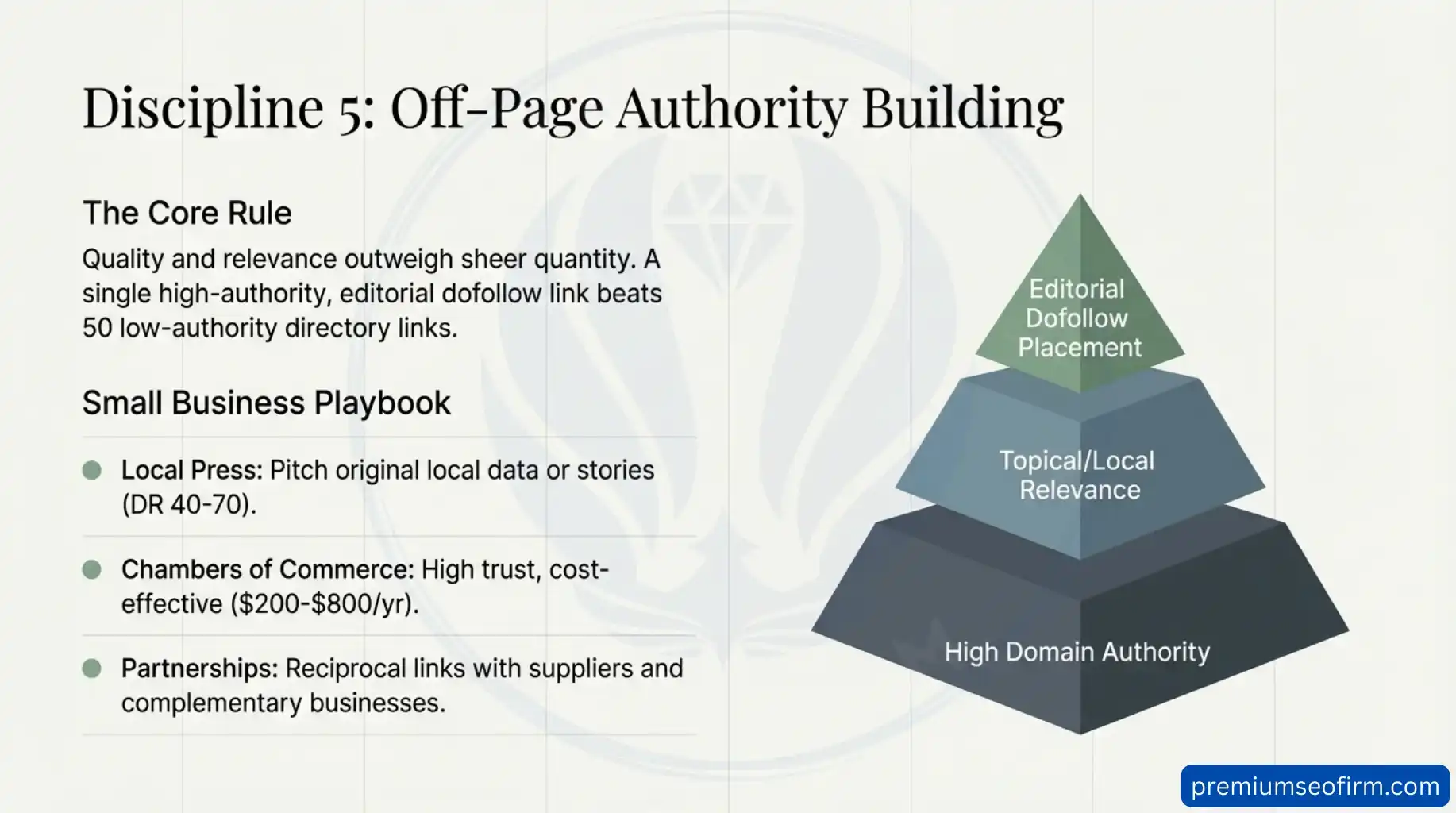
- Local press outreach — pitching story angles to local newspaper websites (typical Domain Rating: 40–70) generates 1–3 editorial backlinks per successful story placement. Geographic relevance of local press backlinks provides dual benefit: link equity transfer and local prominence signals in Google’s local ranking algorithm. Annual Chamber of Commerce membership costs range from $200–$800 for small businesses — a cost-effective backlink acquisition channel.
- Chamber of Commerce and industry association directory listings — Chamber of Commerce membership directory listings carry Domain Ratings of 40–65. Industry association member pages provide topically relevant backlinks alongside professional credibility signals that support E-E-A-T Authoritativeness.
- Supplier and complementary business partner links — reciprocal linking arrangements with material suppliers, referral partners, and complementary non-competing local businesses produce topically relevant backlinks without requiring content creation or paid placements.
- Original local research and data — publishing original local data including neighborhood survey results, service cost comparisons by area, and seasonal demand analysis attracts journalist backlinks from local news outlets and industry publications. Research content generates backlinks passively after initial publication without requiring ongoing outreach, per Ahrefs’ 2024 Content Link Acquisition Analysis.
- Guest contributions to industry trade publications — contributing expert articles to industry trade publications with a named author byline establishes author entity signals strengthening E-E-A-T Authoritativeness and generates topically relevant backlinks from established industry domains.
How Does Content SEO Drive Organic Traffic for Small Businesses?
Content SEO creates the topical authority foundation that allows a domain to rank across multiple long-tail keyword variations simultaneously rather than competing on isolated single keywords. Domains publishing topically complete content across a defined subject cluster achieve significantly more organic impressions than domains publishing isolated standalone pages without topical architecture, per Semrush’s 2024 Topical Authority Analysis of 120,000 domains.
What Is the Google Helpful Content System and How Does It Affect Small Business Content?
The Google Helpful Content System is Google’s content quality classifier — integrated directly into Google’s core ranking infrastructure as of the March 2024 Core Update — that evaluates whether content is created primarily to serve human users seeking genuine information or primarily to rank in search engines without serving genuine user needs. Content the system classifies as created primarily for ranking rather than for people receives active quality score suppression applied at the page level within core ranking infrastructure, per Google’s Helpful Content documentation (2024).
The Helpful Content System evaluates 4 characteristics that directly affect small business content quality scoring:
- Information originality and depth: Pages that add original information — first-hand experience, original data, unique analysis, or perspectives not available on competing pages — score higher than pages that aggregate information already present across other ranking pages. For small businesses, this differentiator favors content drawing on real service experience over generic industry summaries that any competitor could publish without operational knowledge.
- Search intent satisfaction: Pages that fully satisfy the intent of the query triggering the visit — answering the specific question the visitor searched, at the depth the question requires, without leaving gaps that force the visitor to continue searching — score higher than pages that partially address the query. A visitor who clicks a result and immediately returns to Google to continue searching (a behavior pattern measurable as “pogo-sticking”) signals to Google that the page failed to satisfy intent — a Helpful Content quality signal.
- Content written for a primary audience: Pages that demonstrate clear awareness of the specific audience segment the content serves — using vocabulary appropriate to that audience’s expertise level and addressing that audience’s specific decision-making context — score higher than pages written for broad, undefined audiences. A small business HVAC service page written specifically for homeowners in the service area, addressing local seasonal conditions and local contractor licensing requirements, demonstrates audience-specific awareness that a generic “HVAC tips” page does not.
- Absence of content added primarily to increase page length: Paragraphs that introduce no new information, restate facts already established earlier in the same page, or pad page length without advancing the reader’s understanding receive negative Helpful Content quality signals. The practical editorial standard: every paragraph on a published page must contain at least one piece of information a reader seeking the page’s topic specifically needs and cannot find summarized more usefully elsewhere.
What Is Keyword Research and How Does It Guide Small Business Content Strategy?
Keyword research is the process of identifying the specific search queries potential customers use, analyzing each query’s search volume, keyword difficulty, and intent classification, and sequencing content creation to maximize ranking probability within available resources. 4 keyword research platforms serve small business content strategy:
- Ahrefs Keywords Explorer (Ahrefs Pte. Ltd.) — provides keyword difficulty scores (0–100 index scale derived from the median number of referring domains pointing to top-10 ranking pages), monthly search volume across 10 search engines, click-through rate data, and parent topic clustering.
- Semrush Keyword Magic Tool (Semrush Holdings Inc.) — generates 25.5 billion keyword variations with intent classification labels (Informational, Navigational, Commercial, Transactional), monthly search volume, and competitive density metrics.
- Moz Keyword Explorer (MOZ Inc.) — combines difficulty, volume, and estimated CTR opportunity into a Priority Score that surfaces high-potential keywords for domains with limited link authority.
- Google Keyword Planner (Google LLC, included with Google Ads accounts) — provides broad monthly search volume ranges. Better suited for initial brainstorming than competitive analysis — volume ranges are less precise than the 3 specialized tools above.
Long-tail keywords — search queries of 4+ words with monthly search volumes below 1,000 — represent approximately 70% of all search queries and produce higher conversion rates than short-tail keywords (1–2 words), per Moz’s Published Keyword Research Analysis. A small business targeting “emergency plumber [city name] available 24 hours” converts organic visitors at a materially higher rate than a business targeting only “plumber” — the specificity of the long-tail query reflects more immediate purchase intent.
How Does a Topical Content Cluster Accelerate Small Business Rankings?
A topical content cluster is an interconnected group of content pages consisting of 1 pillar page (broad topic overview) linked bidirectionally to multiple cluster pages (narrow sub-topic deep-dives) — collectively signaling topical authority to Google’s document understanding systems across the entire topic group.
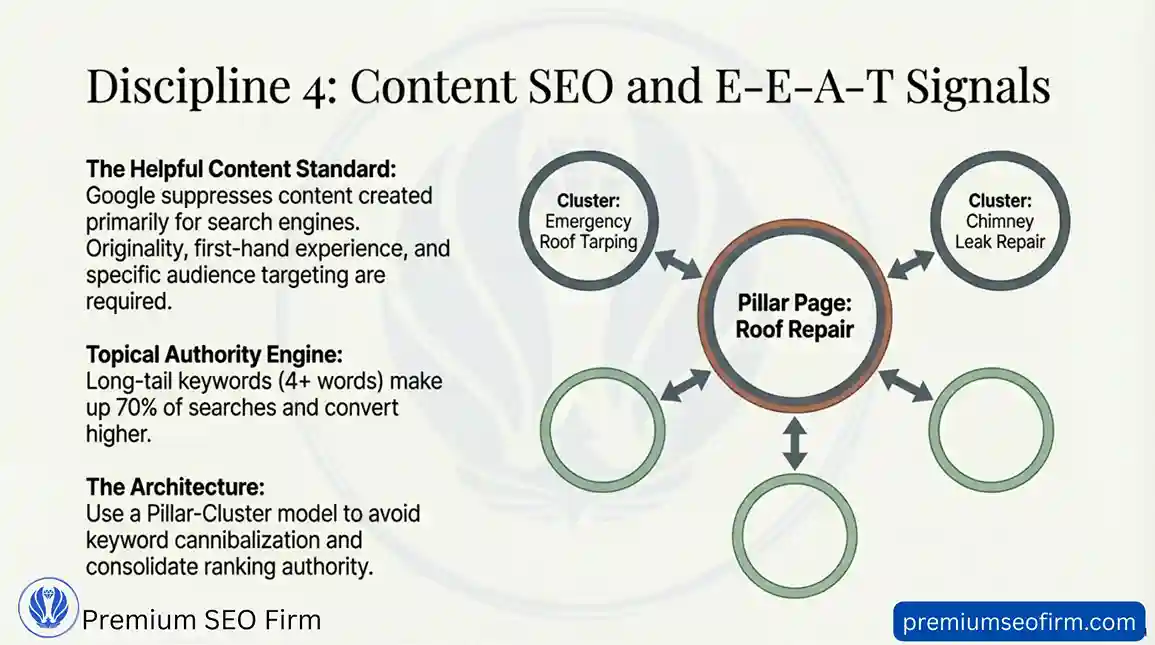
After restructuring HubSpot’s Sales Blog using the topic cluster model, HubSpot reported positive month-over-month growth in first-page keyword rankings alongside expanded keyword appearances on pages 2–3, per HubSpot’s own implementation case study. Each cluster page published adds an additional indexed URL, an additional internal link pathway back to the pillar page, and an additional set of long-tail ranking opportunities — a compounding structure where domain-level topical authority accrues with every publication.
How Does Content Freshness Affect Small Business Search Rankings?
Content freshness affects ranking position for time-sensitive queries through Google’s Query Deserves Freshness (QDF) algorithm, which prioritizes recently updated content for queries involving current events, seasonal topics, and evolving industry information. The freshness signal extends beyond traditional Google search — AI assistants including Google AI Overviews (Google LLC’s generative search result format), ChatGPT (OpenAI LLC’s conversational AI platform), Perplexity (Perplexity AI Inc.’s answer engine), and Gemini (Google LLC’s multimodal AI model) prefer citing fresher content. AI-cited content averages 25.7% fresher than organic Google results across an analysis of 16.975 million citations, per Ahrefs’ 2025 AI Citation Freshness Study. ChatGPT demonstrates the strongest freshness preference, citing URLs 393–458 days newer than organic search results for equivalent queries.
For evergreen service pages targeting stable local queries — including “roof repair [city]” or “family dentist [neighborhood]” — annual review cycles apply the freshness signal through refreshed statistics, updated structured data, and expanded entity coverage rather than continuous republication that risks triggering duplicate content detection.
What Is Keyword Cannibalization and How Does It Damage Small Business Rankings?
Keyword cannibalization occurs when two or more pages on the same domain target the same primary keyword or closely overlapping keyword clusters, causing Google to split ranking consideration between competing pages instead of consolidating authority behind a single URL — suppressing both pages below their individual ranking potential. 3 cannibalization patterns are common on small business websites:
- Service page and blog post overlap — a service page titled “Roof Repair Services in [City]” and a blog post both targeting the same primary [roof repair + city] keyword cause Google to rank neither as strongly as a single consolidated page. Resolution: 301-redirect the lower-authority page to the stronger URL, or differentiate the blog post to target a meaningfully distinct informational sub-query such as “signs you need emergency roof repair vs. standard repair in [city].”
- Homepage and service page competition — a homepage targeting “[plumber] [city]” directly competing with a dedicated “/plumbing-services/” page targeting the same keyword splits click distribution between two under-performing URLs instead of concentrating authority on one optimized page. Resolution: assign the primary commercial keyword exclusively to the service page and optimize the homepage for branded and category-level queries.
- Location page thin duplication — a multi-location business publishing location pages with near-identical body content minus the suburb name swap triggers Google’s Helpful Content System to suppress the entire location page cluster. Resolution: each location page requires substantively distinct locally relevant content — local landmarks, neighborhood-specific service history, area-specific testimonials, or city-specific service notes — that differentiates the page from a template.
The diagnostic for cannibalization is a Google Search Console query analysis: if two or more pages from the same domain appear in the Average Position column for the same primary keyword, a cannibalization issue exists requiring consolidation or differentiation.
How Are Google AI Overviews Changing Small Business SEO?
Google AI Overviews represent the most significant structural change to Google’s results page since the introduction of the Local 3-Pack — appearing for approximately 47–48% of tracked queries in the United States, up from roughly 30% one year prior, directly altering the click distribution available to organic results below them, per BrightEdge’s February 2026 Analysis.
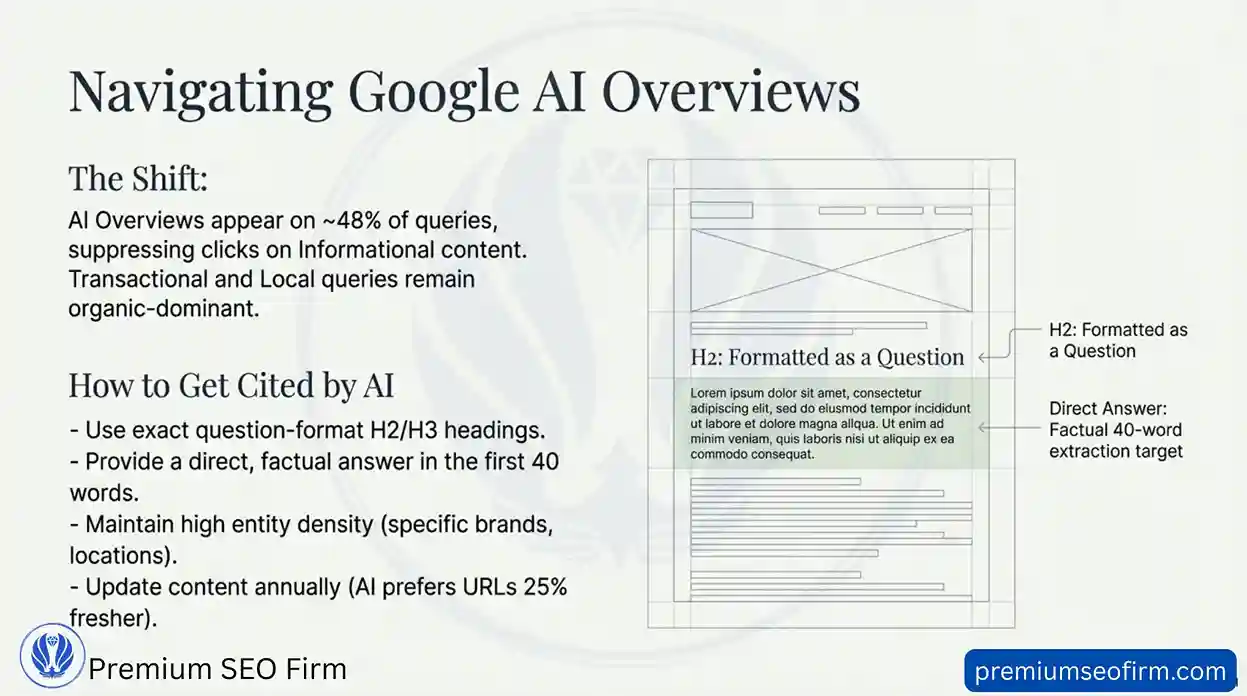
AI Overviews synthesize answers from multiple sources above all organic results — a page ranking in position 3 below an AI Overview receives fewer clicks than the same position 3 result in a SERP without one.
Which Query Types Trigger AI Overviews for Small Business Keywords?
Queries triggering AI Overviews tend to be longer and more specific than queries that do not — indicating Google favors predictable, fact-based questions where a consensus answer can be confidently summarized, per Semrush’s 2025 AI Overviews Study. 2 distinct query categories emerge with different optimization implications for small business keyword strategy:
Informational queries are increasingly AI Overview territory. Queries like “how long does pipe relining last,” “what causes roof leaks around chimneys,” or “average cost of a dental cleaning” frequently return AI Overviews that partially satisfy user intent before a click occurs. Small businesses publishing informational blog content see reduced click-through on informational pages even when those pages are cited as sources within AI Overviews — the AI Overview partially satisfies the user’s need before reaching the source page.
Transactional and local queries remain organic-dominant. Queries like “emergency plumber [city],” “[business name] contact,” and “roof inspection near me” trigger AI Overviews significantly less frequently because these queries require real-time local availability, specific pricing, and entity-level data that AI cannot reliably generalize. Transactional and navigational queries remain the primary organic traffic driver for small business service pages.
How Do Small Businesses Get Cited in AI Overviews?
AI Overview citation behavior is consistent with 4 structural content characteristics observed across practitioner analysis and supported by Ahrefs’ 2025 Study of 16.975 million AI citations across ChatGPT, Perplexity, Gemini, Microsoft Copilot (Microsoft Corporation’s AI assistant), and Google AI Overviews:
- Direct answer structure — pages opening with a clear, concise answer to the query in the first 1–2 sentences before expanding into supporting detail. AI extraction systems surface the most direct answer available — pages burying answers beneath lengthy introductions are cited less frequently than pages where the answer is the first meaningful sentence.
- Question-format H2 and H3 headings — headings phrased as exact or near-exact match questions increase the probability that specific heading-and-answer pairs are extracted for AI Overview citation. A heading “How long does pipe relining last?” followed by a 40-word direct answer paragraph is structurally optimized for AI Overview extraction.
- Content freshness — AI-cited content averages 25.7% fresher than standard organic Google results, per Ahrefs’ 2025 Analysis. Annual content updates refreshing statistics and expanding entity coverage increase AI Overview citation probability for evergreen service pages.
- Named entity and factual density — pages including specific named entities (product brands, certifications, measurable outcomes, named locations) alongside factual claims give AI Overview extraction systems verifiable data points to attribute. Vague content with no specific entities provides less extractable material than fact-dense content with clear attribution.
Does AI Overview Optimization Compete with Traditional Organic Ranking Optimization?
The optimization strategies for AI Overview citation and traditional organic rankings are nearly identical — pages structured for AI Overview citation simultaneously satisfy on-page optimization requirements for traditional organic rankings. AI Overview optimization is an extension of existing content quality investment, not a separate competing discipline requiring additional resources.
The primary strategic implication for small businesses is rebalancing informational versus transactional content investment. Informational content answering general questions is increasingly subject to zero-click AI Overview responses. Transactional, commercial investigation, and location-specific service content — which captures higher-value visitors closer to purchasing — remains substantially less exposed to AI Overview click suppression. New content investment weighted toward commercial investigation and transactional intent topics preserves organic click value, while informational content serves topical authority support rather than standalone traffic acquisition.
How Do Small Businesses Measure SEO Performance?
Small business SEO performance measurement relies on 3 diagnostic platforms — Google Search Console, Google Analytics 4, and Ahrefs Webmaster Tools — that together provide visibility into the 5 metrics connecting SEO activity to business revenue. Each platform provides data the others do not — operating with only 1 or 2 platforms creates measurement blind spots.
- Google Search Console (Google LLC, free) — provides impression and click data by query and by page, average position for all ranked keywords, Core Web Vitals field data from the Chrome User Experience Report, indexation status across all crawled URLs, manual action notifications, and crawl error logs organized by error type. Google Search Console is the authoritative source for organic search performance data and the only platform with direct Google index status visibility.
- Google Analytics 4 (Google LLC, free — replaced Universal Analytics as of July 2023) — provides organic traffic volume by acquisition channel, user engagement metrics including session duration and pages per session, goal conversion tracking for form submissions and phone call clicks, and audience demographic data. Google Analytics 4 is the only platform connecting organic traffic volume to defined business revenue outcomes.
- Ahrefs Webmaster Tools (Ahrefs Pte. Ltd., free for verified site owners) — provides Domain Rating, URL Rating, inbound backlink profile data, organic keyword ranking history, and a technical SEO site audit covering 100+ issue categories. Ahrefs Webmaster Tools provides backlink and domain authority data that neither Google-native platform supplies.
What SEO Metrics Matter Most for Small Business Decision-Making?
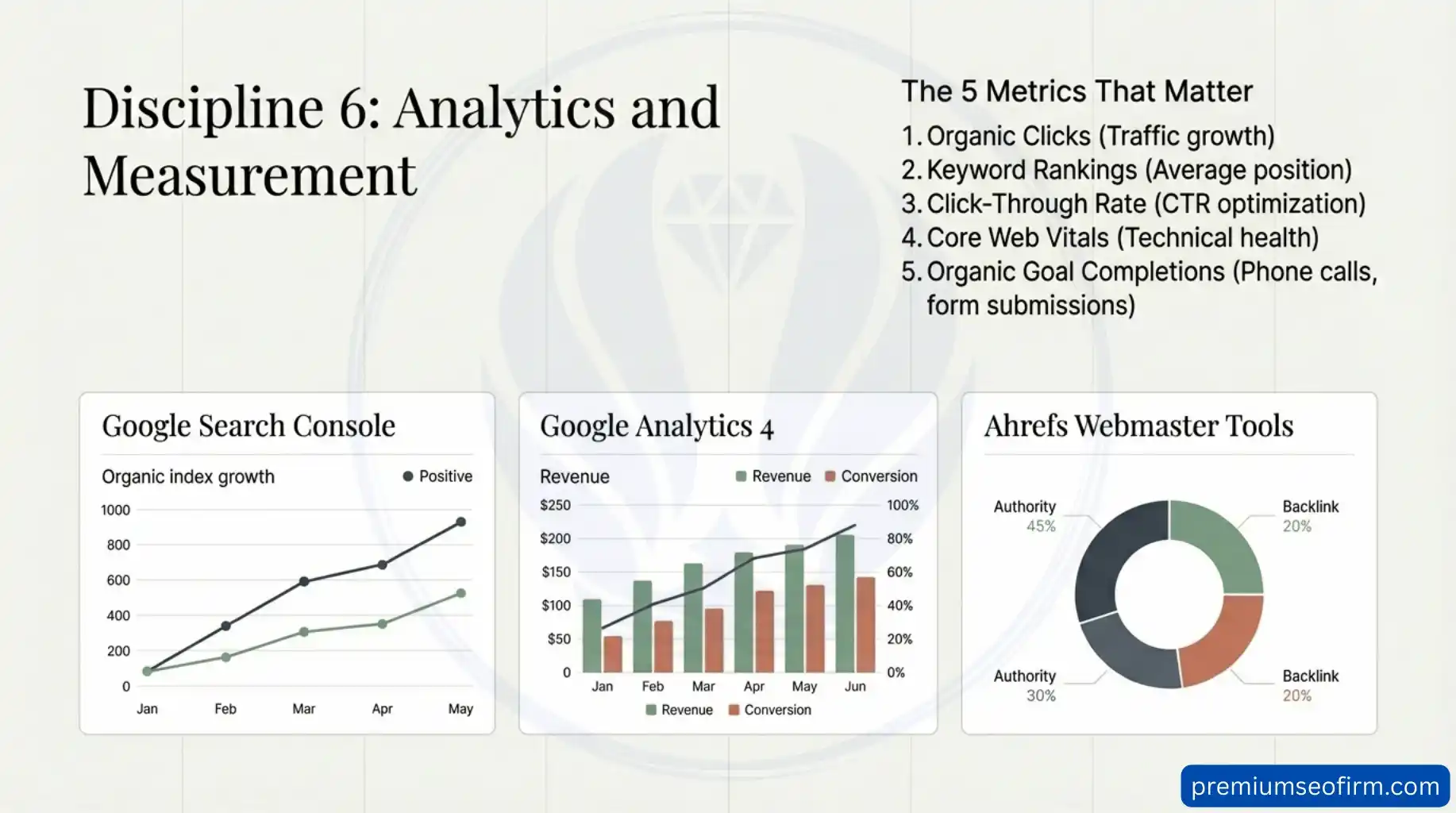
5 primary SEO metrics determine whether a small business’s SEO investment produces measurable business outcomes:
- Organic clicks — the total number of website visits generated from Google Search per month, tracked in Google Search Console’s Performance Report. Consistent month-over-month organic click growth confirms that ranking position improvements and CTR optimizations are translating to actual traffic growth.
- Keyword ranking positions — the average ranking position for each primary service keyword, tracked weekly in Google Search Console or Ahrefs Webmaster Tools. Ranking positions above 10 (first page) generate 92% of search traffic — positions below 10 generate effectively zero clicks for most keyword difficulty levels.
- Click-through rate (CTR) — the percentage of users clicking a result after seeing it in Google Search, reported in Google Search Console by page and by query. Average CTR below 2.5% for pages in positions 4–10 indicates title tag and meta description optimization opportunity.
- Core Web Vitals scores — LCP, CLS, and INP scores for the top 20 organic landing pages, tracked in Google Search Console’s Core Web Vitals Report. Pages with “Poor” Core Web Vitals status face a confirmed direct ranking suppression — remediation produces both a ranking improvement and a conversion rate improvement simultaneously.
- Organic goal completions — phone calls, form submissions, direction requests, and booked appointments attributed to organic search traffic in Google Analytics 4. Organic goal completions connect SEO investment to revenue — the definitive measure of SEO return on investment for small businesses.
How Do Small Businesses Conduct a Competitor SEO Analysis?
A competitor SEO analysis identifies the specific pages, keywords, backlink sources, and content gaps driving organic traffic to competitor domains — providing a reverse-engineered roadmap that replaces guesswork with proven-demand data for content and link-building priorities. Search competitors are the domains ranking on page 1 for target keywords — not necessarily the same businesses competing for customers offline.
5-step competitor SEO analysis process for small businesses:
- Identify true search competitors — run the 5 highest-priority service keywords in Ahrefs Site Explorer (Ahrefs Pte. Ltd.) or Semrush Site Explorer (Semrush Holdings Inc.). The domains appearing most frequently in top 10 results across those keywords are the search competitors. National directories including Angi (Angi Inc.), Yelp (Yelp Inc.), and HomeAdvisor (IAC/InterActiveCorp) frequently rank above local businesses and require different competitive responses than local competitor businesses.
- Audit competitor top-performing pages — use Ahrefs’ Top Pages Report to identify which competitor pages drive the most estimated organic traffic. Each top-performing competitor page without an equivalent on the target domain is a direct content gap to fill.
- Analyze competitor on-page elements — examine title tags, H1 headings, URL structure, word count, internal linking patterns, and structured data on ranking competitor pages. Elements present on ranking competitor pages but absent from the target domain’s equivalent pages represent the highest-priority on-page fixes.
- Identify replicable backlink sources — export referring domains from Ahrefs for the 3 highest-authority competitors, sorted by Domain Rating descending. Backlink sources appearing across multiple competitors but absent from the target domain are priority acquisition targets. Local chambers, industry associations, and local news outlets represent the most replicable sources for small businesses.
- Run a content gap analysis — use Ahrefs’ Content Gap Tool (Site Explorer → Content Gap) to identify keywords that multiple competitors rank for but the target domain does not. The content gap report is the most direct input for Phase 3 content page creation priorities — each gap keyword represents a proven query with demonstrated search demand that the target domain has not yet addressed.
What Are the Most Common Small Business SEO Mistakes?
Small businesses make 7 documented SEO mistakes that suppress rankings, prevent indexation, or waste optimization resources on low-impact activities — each producing a confirmed negative consequence on organic search performance.
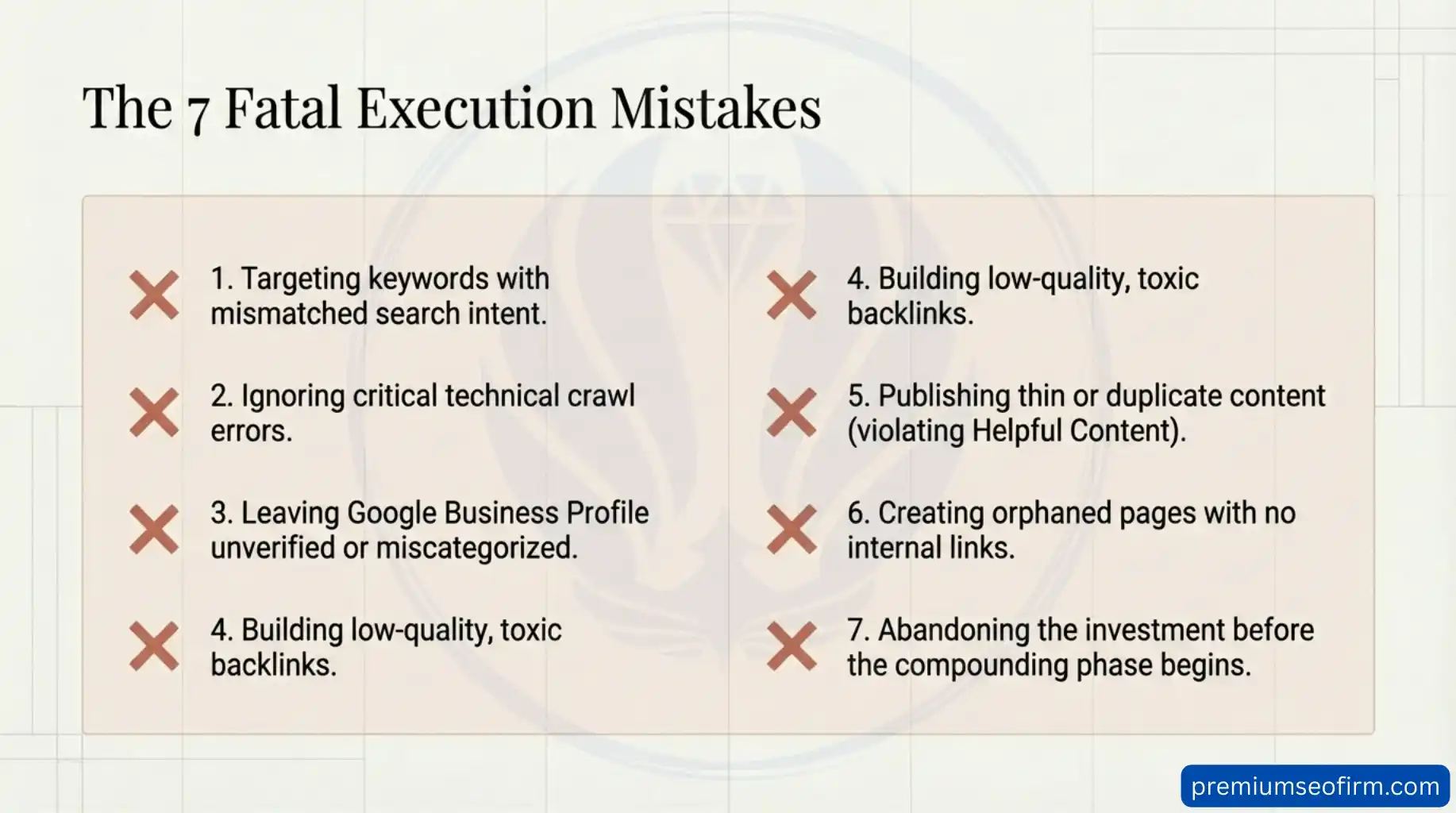
- Targeting keywords with mismatched search intent — publishing informational content on pages Google expects to serve transactional queries creates structural intent mismatches. Google demotes intent-mismatched pages from top-10 positions regardless of content quality, backlink count, or on-page optimization quality. A plumbing business publishing “What Is Pipe Relining?” as its main service page URL fails both informational and transactional intent audiences simultaneously.
- Ignoring technical SEO foundations — investing in content and link building while leaving crawl errors, failing Core Web Vitals, and mobile usability issues unresolved produces no ranking improvement. Googlebot cannot rank content Googlebot cannot access and render. Sites with critical crawl errors show measurably lower indexed page counts than technically healthy competitor sites, per enterprise audit data from Screaming Frog Ltd.
- Leaving Google Business Profile unverified or miscategorized — an unverified GBP removes a small business from Local 3-Pack eligibility entirely. An incorrectly categorized GBP reduces query matching for the most valuable local service keywords. GBP primary category selection is the single most important Local Pack ranking factor, per Whitespark’s 2026 Local Search Ranking Factors Survey.
- Building low-quality or irrelevant backlinks — links from link farms, private blog networks (PBNs), and topically unrelated directories produce negative authority signals. Sites penalized by Google’s manual action team for unnatural link profiles experience significant organic traffic loss within 30 days of penalty notification, per practitioner case studies documented in SEO industry publications. The Google Disavow Tool (Google LLC’s link profile management tool) allows removal of toxic links from authority calculations, but manual action recovery typically requires 3–6 months.
- Publishing thin or duplicate content — pages containing fewer than 300 words, pages duplicating content from other domain URLs without canonical tag implementation, and pages with unnatural keyword repetition receive lower quality scores from Google’s Helpful Content System — Google’s content quality classifier integrated directly into core ranking infrastructure as of the March 2024 Core Update.
- Ignoring internal linking structure — publishing new pages without pointing internal links from existing pages creates orphaned pages that Googlebot rarely discovers, crawls, or ranks. Every new page published requires at least 2 internal links from relevant existing domain pages.
- Abandoning SEO investment before the compounding phase — 72.9% of pages currently ranking in Google’s top 10 are more than 3 years old, and only 1.74% of newly published pages reach the top 10 within a year, per Ahrefs’ Study of 1–2 million randomly selected pages. Small businesses that pause investment before authority accumulates receive zero measurable return from the investment already made.
How Should Small Businesses Prioritize Their SEO Strategy?
Small businesses with limited budgets and team capacity implement SEO through a 4-phase sequence — Technical Foundation, On-Page and Local Optimization, Content Expansion, and Authority Building — where each completed phase multiplies the effectiveness of the next phase’s investment.
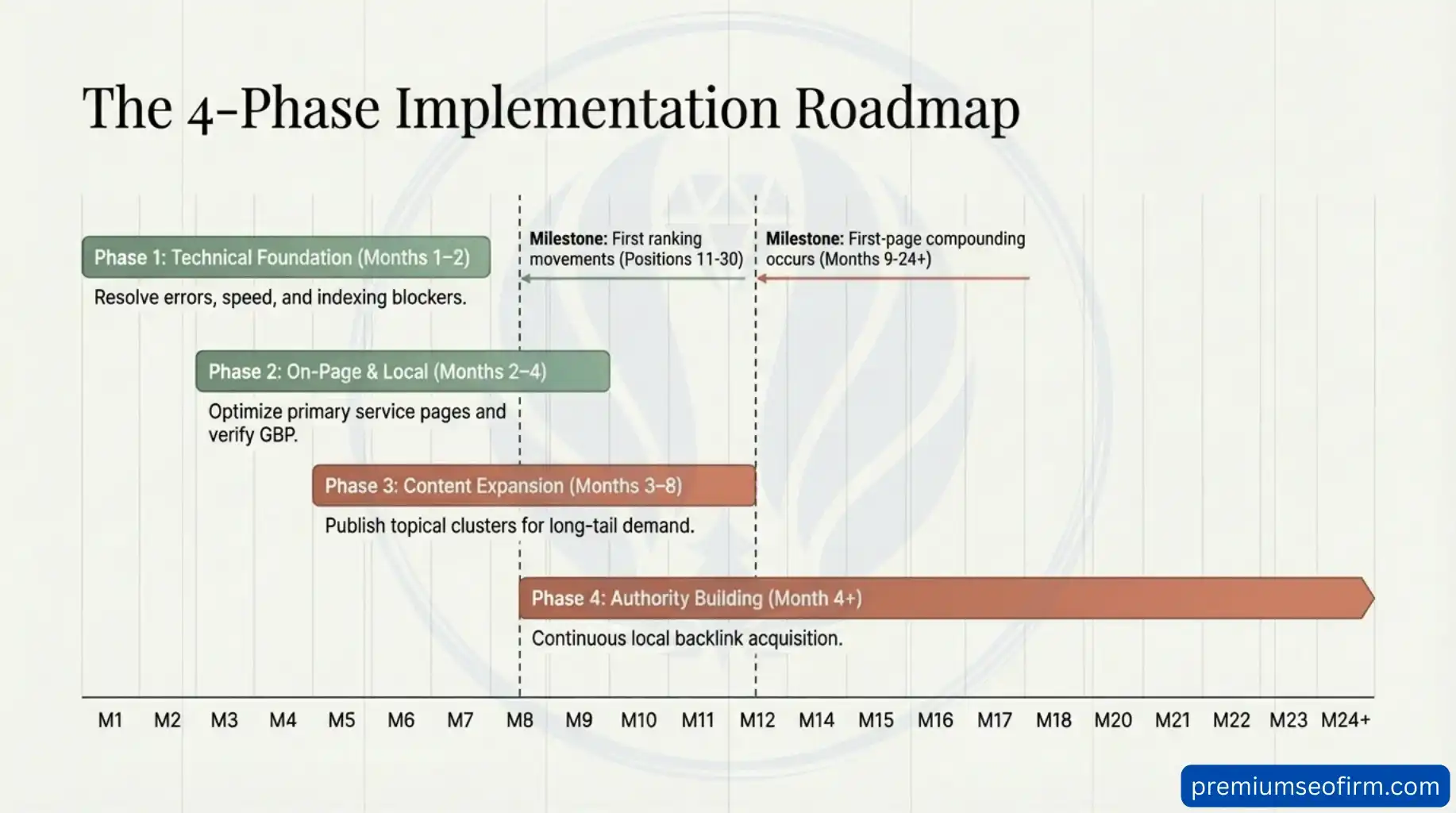
Advancing to the next phase before completing the current phase’s measurable criteria wastes resources on an unstable foundation.
Phase 1 — Technical Foundation (Months 1–2)
Phase 1 resolves all technical SEO blockers before any content or backlink investment begins — a technically inaccessible website cannot benefit from on-page optimization or off-page authority building regardless of investment volume. Phase 1 activities:
- Verify Google Search Console access and confirm domain ownership
- Submit an accurate XML sitemap to Google Search Console
- Resolve all Coverage Report errors including server errors (5xx), redirect errors, and soft 404s
- Achieve Core Web Vitals “Good” status across the top 20 organic landing pages
- Confirm mobile usability compliance across all primary service pages
- Implement HTTPS and configure the HTTPS property in Google Search Console
- Resolve all redirect chains to single direct 301 redirects
3 Phase 1 completion criteria (all 3 required before advancing to Phase 2):
- Google Search Console Coverage Report shows zero server errors and zero redirect errors across all indexed page categories
- Google Search Console Core Web Vitals Report shows zero “Poor” status pages for the top 20 organic landing pages
- Google’s Mobile-Friendly Test confirms zero usability errors across all primary service pages
Phase 2 — On-Page and Local Optimization (Months 2–4)
Phase 2 optimizes the highest-priority service pages across all 12 on-page relevance signals and establishes the local search foundation through Google Business Profile verification and initial citation building. Phase 2 activities:
- Optimize the 5 highest-priority service pages across all 12 on-page elements
- Complete Google Business Profile verification and select the most specific accurate primary category
- Build initial NAP citations across the top 10 local directories
- Add LocalBusiness schema markup to all service and location pages
- Resolve navigational intent ranking failures where the homepage does not rank first for the brand name
3 Phase 2 completion criteria (all 3 required before advancing to Phase 3):
- Google Search Console Queries Report shows at least 1 impression per month for each primary target keyword, confirming Google associates each page with its target query
- Google Business Profile shows “Verified” status, primary category is set, and the listing appears in Google Maps for at least 1 branded search query
- Screaming Frog crawl of the domain shows zero missing title tags, zero duplicate H1s, and zero missing meta descriptions across all 5 priority service pages
Phase 3 — Content Expansion (Months 3–8)
Phase 3 expands the domain’s topical authority through systematic long-tail content creation — publishing 2–4 new topically relevant pages per month targeting long-tail keyword clusters identified in the content gap analysis. Phase 3 activities:
- Structure all new pages around a pillar-cluster architecture with question-format H2 headings and direct 40-word answer blocks for AI Overview eligibility
- Add at least 2 internal links from existing pages to every newly published page
- Update the XML sitemap after each content publication batch
- Monitor Google Search Console impressions monthly to confirm topical authority expansion
3 Phase 3 completion criteria (all 3 required before prioritizing Phase 4):
- Ahrefs Webmaster Tools keyword ranking history shows organic keyword appearances across at least 3 distinct content topic clusters beyond the primary service category
- Google Search Console total impressions data shows month-over-month growth in unique queries generating at least 1 impression
- Internal link audit confirms all published cluster pages have at least 2 internal links from previously published pages
Phase 4 — Authority Building (Month 4 Ongoing)
Phase 4 initiates structured backlink acquisition after technical foundations and content are established — backlinks pointing to well-built pages produce significantly greater ranking improvements than equivalent backlinks to thin or technically flawed pages, per Ahrefs’ 2024 Link Impact Analysis. Given that 72.9% of top-10 ranking pages are more than 3 years old (Ahrefs, 2025), Phase 4 is an ongoing investment — not a time-limited campaign. Phase 4 activities:
- Local press outreach targeting 1–2 story pitches per month
- Chamber of Commerce and industry association membership directory submission
- Supplier and complementary partner link exchange outreach
- Monthly Ahrefs Domain Rating and referring domain count review
3 Phase 4 ongoing health indicators (monthly review):
- Ahrefs Webmaster Tools shows month-over-month growth in referring domain count — new referring domains matter more than additional links from existing domains
- Google Search Console Security & Manual Actions Report shows zero manual action notifications
- Domain Rating trend is increasing on a trailing 6-month basis, confirming link acquisition is producing domain-level authority accumulation
Stakeholder Perspectives on Small Business SEO in Practice
The Service Business Losing Jobs to Locally Visible Competitors
A plumbing business operating without local SEO receives none of the 42% of clicks that Google Map Pack results capture for local queries, per Backlinko’s 2024 Research — including clicks from customers geographically closer to the unoptimized business.
The 3 most impactful actions for appearing in the Local 3-Pack are: optimizing the Google Business Profile primary category (the single most important Local Pack ranking factor per Whitespark’s 2026 Local Search Ranking Factors Survey), maintaining consistent NAP data across citation sources (making businesses 40% more likely to appear in the Local Pack per Whitespark’s 2026 survey via BrightLocal), and generating a steady volume of positive reviews received within the last 90 days (the second most important Local Pack ranking factor per the same survey).
Each of these 3 actions costs zero media spend — the resource required is implementation time, not advertising budget.
The Restaurant Owner Who Increased Reservations Through Local SEO
A restaurant owner who claimed, completed, and actively maintained a Google Business Profile — including a review count averaging 4.5 stars, weekly Google Posts, and consistent photo uploads — experienced significant increases in online reservation volume within 6 months of implementation.
The reservation increase required zero paid advertising spend during the measurement period — the traffic source was entirely organic local search driven by Google Business Profile activity. The critical difference between the before and after states was not a ranking algorithm change but a profile completeness gap: an incomplete GBP suppressed Local 3-Pack eligibility that profile completion restored.
The Professional Services Business Navigating YMYL E-E-A-T Requirements
A dental practice, law firm, or independent financial advisor operates in a YMYL (Your Money or Your Life) category — topic areas where Google’s Quality Rater Guidelines apply heightened E-E-A-T scrutiny because content in these categories directly affects the health, financial stability, or legal standing of the reader. For professional service businesses in YMYL categories, E-E-A-T Expertise and Trustworthiness signals are structural ranking prerequisites — not refinements. 4 implementation requirements differentiate YMYL professional service SEO from general small business SEO:
- Named author credentials on every content page — a dental practice blog post about root canal procedures must display the authoring dentist’s name, dental license number, years of practice, and DDS credentials alongside the content. An unsigned or generically authored professional service article scores low on E-E-A-T Expertise regardless of content quality, per Google’s Quality Rater Guidelines definition of Expertise for medical and legal topics.
- License and regulatory body verification on service pages — a law firm’s service pages should display State Bar association membership, practice area certifications, and years of admission to practice. A financial advisor’s service pages should display CFA, CFP, or registered investment advisor credentials alongside regulatory body membership. These signals are cross-referenceable by Google’s quality evaluation systems against public professional registries.
- Structured author pages as E-E-A-T anchors — each licensed professional at the practice requires a dedicated author page declaring credentials, education, professional memberships, speaking engagements, published work, and patient or client outcomes (with appropriate regulatory disclosure). Internal links from every content page to the relevant author page create a consistent E-E-A-T signal chain across the domain.
- Review quantity and specificity benchmarks — for dental and medical practices, review volume requirements are higher than general service businesses because patients compare credential signals across multiple providers before making health decisions. Practices with fewer than 50 Google reviews in a competitive market compete at a structural Prominence disadvantage against practices with 200+ reviews, regardless of equivalent clinical quality.
The SEO Agency Establishing a Technical Baseline for a First-Time Client
SEO agencies onboarding first-time small business clients establish a technical audit baseline before any content creation or backlink acquisition begins. Agencies using Screaming Frog SEO Spider (technical SEO crawling tool developed by UK-based agency software provider Screaming Frog Ltd., first released in 2010) identify crawl errors, duplicate content, missing structured data, and Core Web Vitals failures across a client’s entire domain in a single audit session.
Clients with 15+ critical crawl errors in Google Search Console’s Coverage Report receive Phase 1 technical remediation before any Phase 2 or Phase 3 activities begin — establishing the technical foundation that all subsequent investment depends on. The agency’s measurable Phase 1 output is not a ranking improvement but a Coverage Report status change: the number of “Crawled but not indexed” and “Discovered but not yet indexed” pages in the Coverage Report decreases to zero across all priority service pages.
Conclusion
68% of all online experiences begin with a search engine, per BrightEdge’s Digital Channel Performance Report. Small businesses implementing SEO for small businesses as an integrated 6-discipline system — technical SEO, on-page SEO, local SEO, off-page SEO, content SEO, and analytics — build organic search visibility that compounds over years rather than evaporating when a budget runs out.
4 principles distinguish effective small business SEO from activity producing no measurable return:
- Technical foundations precede all other investment. Content and links produce zero ranking improvement on a website that Googlebot cannot fully access and index.
- Intent alignment determines content format. Publishing the correct content format for each detected intent type is a prerequisite for ranking — not a refinement applied after ranking is achieved.
- Local competitive advantages are structural. Geographic proximity, niche keyword depth, and first-person E-E-A-T Experience signals are advantages that national brands cannot eliminate with budget alone. These advantages require deliberate activation through Google Business Profile optimization, citation consistency, and experience-rich content.
- Compounding requires sustained investment. 72.9% of pages ranking in Google’s top 10 are over 3 years old, per Ahrefs (2025). The compounding mechanisms — authority accumulation, topical depth, and index expansion — produce their return on a multi-year timeline. Abandoning investment before the compounding phase produces zero return on the resources already committed.
Small businesses following the 4-phase implementation sequence, measuring the 5 core SEO metrics consistently, and maintaining investment through the compounding phase build organic search visibility that outperforms equivalent paid advertising investment on a per-visit cost basis — permanently, and without per-click dependency.
A Step-by-Step guide for small business owners to learn and practice: How this Sydney cosmetic dental SEO case study achieved 27% YoY growth and how a dental practice in Waterford achieved 12,800% organic growth.

Talha Rehman is a seasoned SEO expert with over a decade of experience and the Founder & CEO of Premium SEO Firm. He delivers complete white-hat SEO services with a focus on manual blogger outreach, ethical link building, and sustainable organic growth. Talha is passionate about writing in-depth articles on the latest SEO trends, algorithm updates, and proven digital marketing strategies.